Breaking the Therapy Dog Mold: How Zeena the Whippet Thrives in Animal-Assisted Occupational Therapy
I’ve never liked doing things the easy way. I think that’s why I relate to my more “oppositional” clients so well.
I’m just a bit, well…contrarian.
So when I decided to add a therapy dog to my practice, did I go get an easy-going golden retriever? Start with a blank-slate puppy?
No and no.
Five dogs into my work as an animal-assisted speech therapist, ALL of my dogs have come from non-traditional breeds for therapy dog work and some have been already mature dogs. Despite this, I’ve had predominantly positive, though not necessarily easy, experiences.
(My Catahoula, Bodhi, only worked one year as a therapy dog before it became clear the one-dog-to-many-people model didn’t suit his more introverted, intense personality; he transitioned smoothly to one-to-one service work though, as featured in this article).
So when I found Pippa Martin featuring her occupational therapy dog Zeena on Instagram, I instantly felt a connection.
As a small-bodied Whippet who loves active play, she is not the stereotypical partner for an animal-assisted therapist, but she is clearly bringing delight to all who know her.
I reached out to Pippa to explore why she chose a non-traditional therapy dog breed, how she’s found a calling creating resources for other animal-assisted interventionists, and what’s on her horizon as she explores new AAT possibilities…
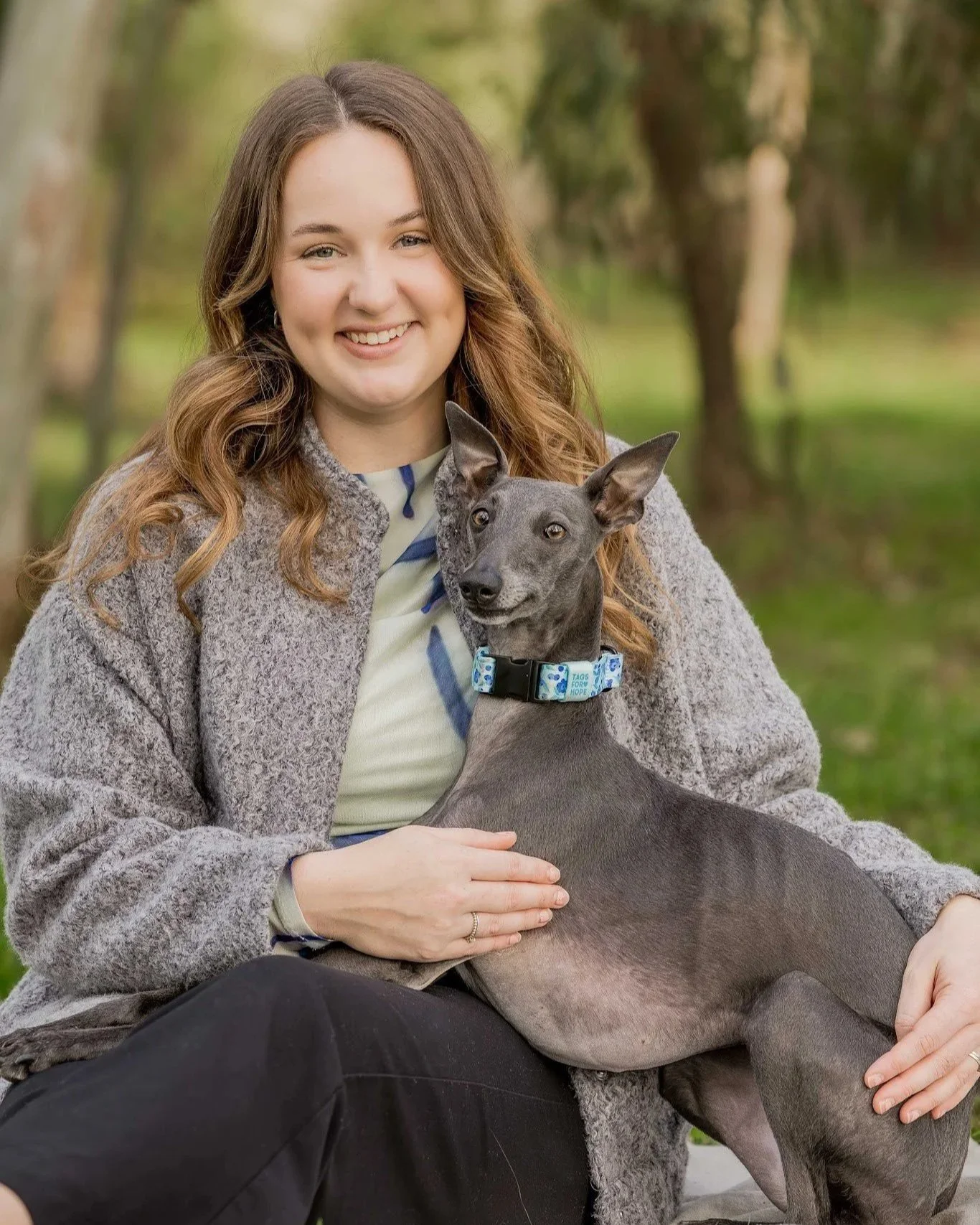
Pippa Martin and her therapy dog partner Zeena provide animal-assisted occupational therapy to kids in Australia.
Follow Zeena to see her big personality on Instagram @zeena.therapydog or Tiktok @zeena.therapy.dog
Pippa, thanks for sharing your experiences with us. Can you tell us a bit about how you got started in animal-assisted occupational therapy and how your therapy dog, Zeena, came into your life?
I had no idea what a therapy dog or animal-assisted therapy was until after I actually had Zeena. She was about 10 weeks old when I saw a TikTok of a therapy dog. From there, I researched more and realised the characteristics I was seeing in Zeena suited her perfectly to be a therapy dog.
I have always loved dogs and saw all the evidence and positive experiences people have had with therapy dogs, and thought it would be the perfect modality to train in.
For those who might be unfamiliar with the Whippet breed, what are their most defining characteristics? Do you feel like these have made it easier or harder to integrate her into your work, or are they simply “differences”?
Whippets make exceptional therapy dogs because their energy level provides a quiet, calm presence that supports regulation in clients. Whippets love cuddles and being around people, preferably as close as possible.
Perfectly balancing an indoor "couch potato" persona with an outdoor love for active play, their compact size allows them to easily share a therapy chair, serving as a versatile, gentle partner for both emotional regulation and physical movement.
Having seen Zeena as a therapy dog and all the amazing qualities whippets have, I will always be choosing whippets for my future therapy dogs (also because they suit my lifestyle perfectly).
However, on the flip side, her most challenging behaviour is her prey drive and wanting to chase moving things, which is something that we are still working on, but is managed with a leash and crate training.
Whilst some things were more challenging, such as recall, it was not impossible and just relied on us building a bond and training her as a sighthound, not as a retriever.
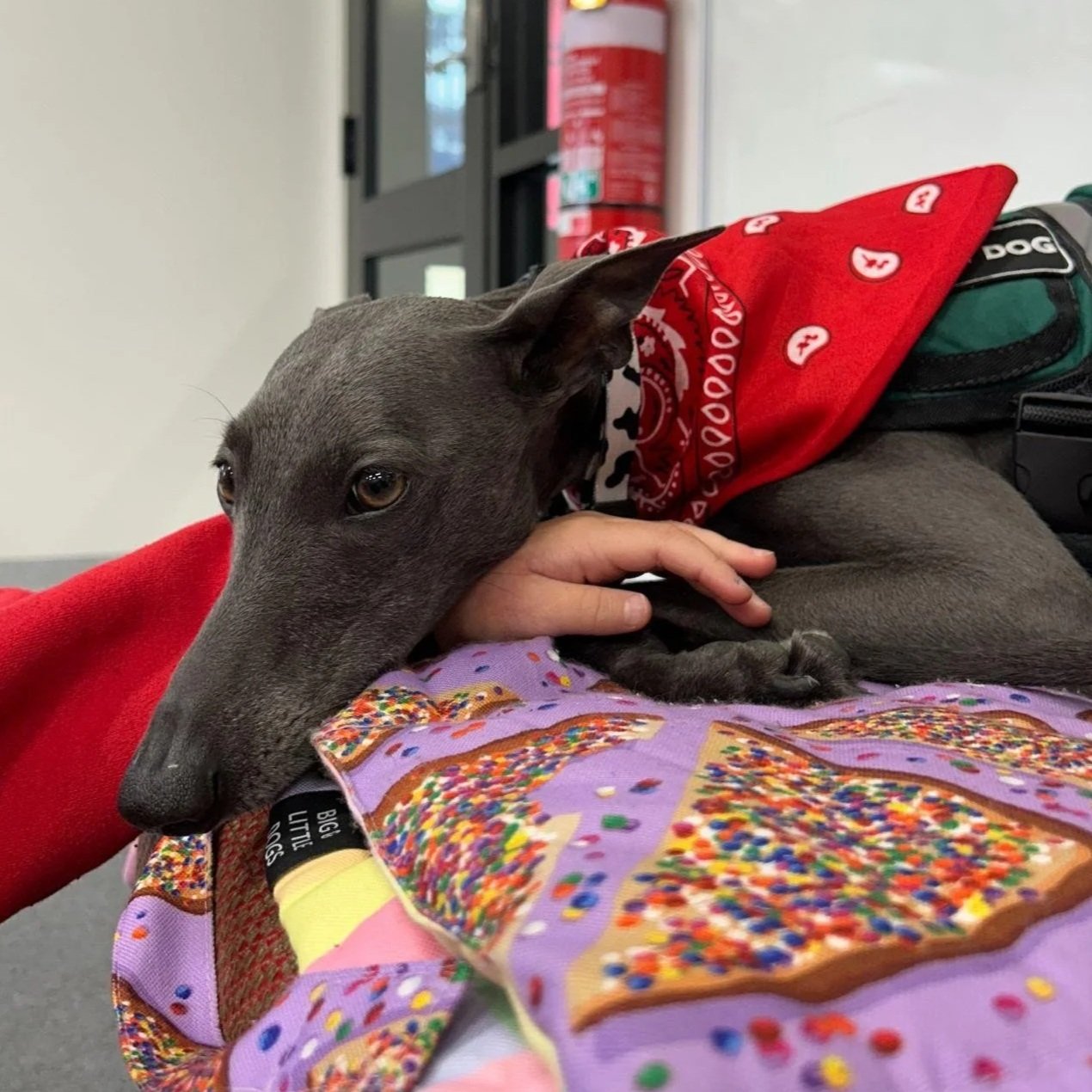
Occupational therapy dog Zeena provides much-needed support to children who might otherwise avoid working toward challenging goals.
Do you find Zeena needs anything special to help her thrive at work that a more traditionally seen breed (Lab, Retriever, Poodle/Doodle) might not require?
100%. She needs a comfy mat in order to settle in a classroom or clinic room; without it, she just isn’t comfy. Not only that, she needs to be able to burrow under it to get all cozy. It always gets a laugh from the kids when she does her funny antics.
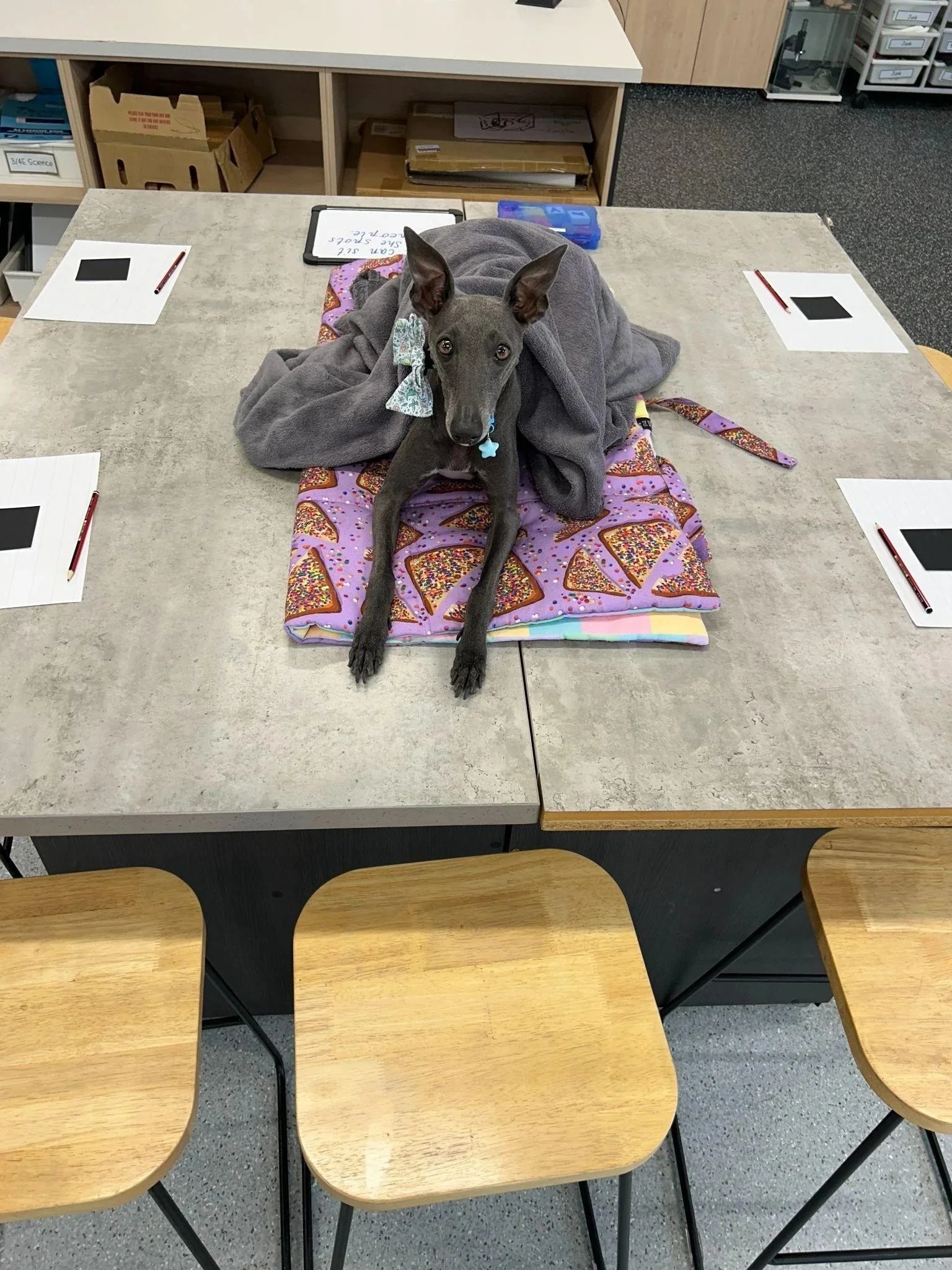
Animal-assisted occupational therapist Pippa Martin knows her partner Zeena needs the ability to burrow to feel her best.
This kind of adaptability in handling and setting up the work environment based on an individual therapy dog’s needs is important to their long-term well-being.
She does need regular breaks; however, I don’t feel that’s Zeena-specific, but rather my role as a therapy dog handler to ensure she is comfortable and has the energy to engage. This can look like scheduling sessions where she is engaging in activities with one client or just sleeping next to the next client.
As I mentioned before, recall was trained slightly differently and maybe more intensively than another breed, but certainly not impossible.
Can you share a favorite moment of two from working alongside Zeena where you feel like her presence made an extra special impact on a child’s progress?
We previously worked in a school-based setting, and that involved groups of 4 students and whole-class visits. It got to a point that Zeena knew the kids in our groups and would show more affection with them, such as lying down with her head on their lap for one student.
School was not their favourite place to be, so having her provide them with comfort, but also her seeking them out, really touched them (and they loved sharing that with their friends).
A client of mine at the clinic honestly could not care less how I am doing but always, always asks how is Zeena, what cheeky thing has she done, what new food has she tried, etc. etc..
This love of [my therapy dog] works into writing letters to Zeena (handwriting is a goal) and I’ve intertwined Zeena-themed activities in all aspects of her goals. The motivation to engage is polar opposite to activities without Zeena.
I have also never seen such consistent behaviour in group based session as they know they need to be safe for Zeena but also just due to her presence.
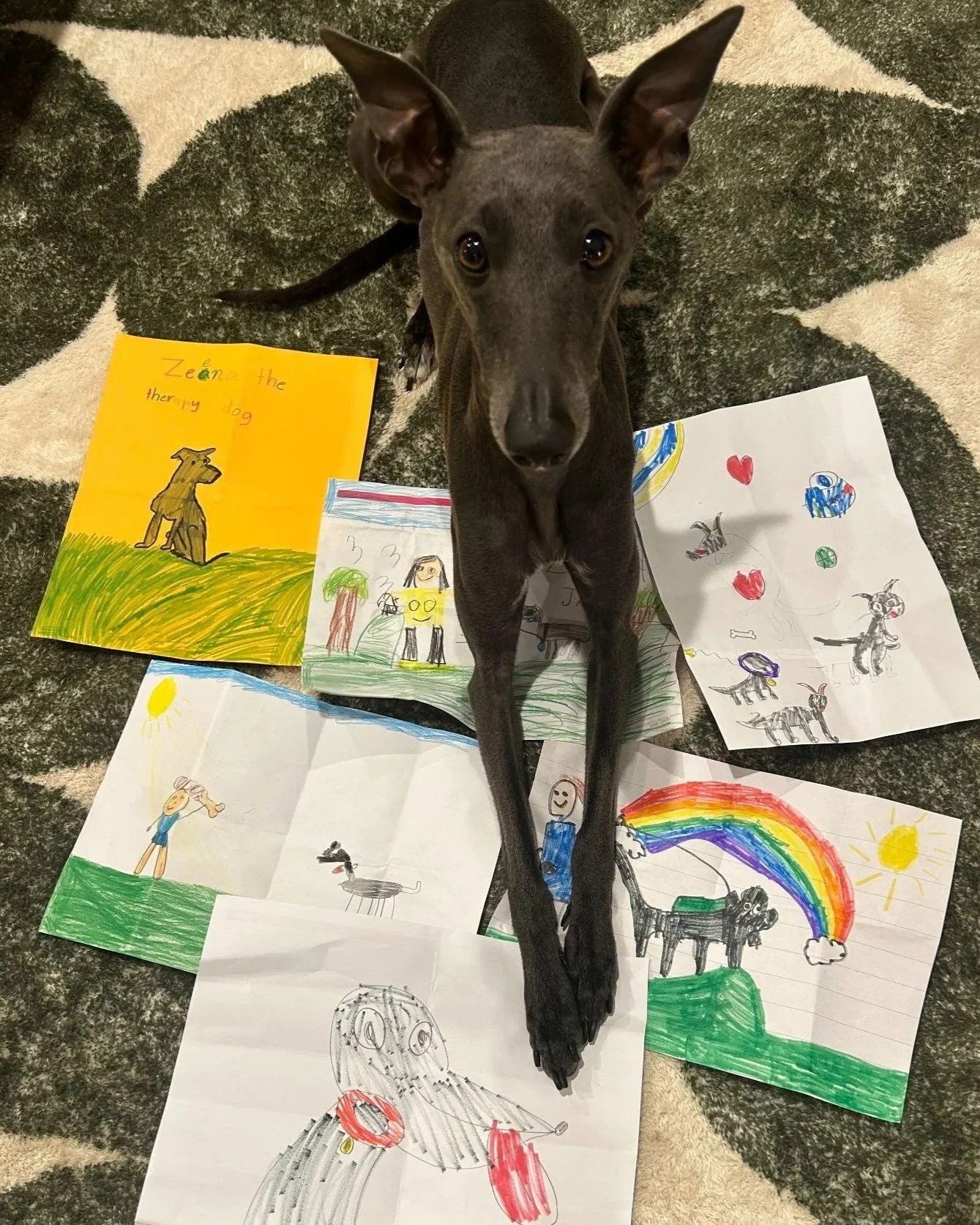
Zeena the Whippet brings joy and motivation to her animal-assisted occupational therapy clients.
Here she poses with a little “fan mail.”
I know firsthand that bringing a therapy dog to work is not easy. How has Zeena’s presence impacted your work life to make it worth all the extra time and effort?
You are so right, my Therapy Dog trainer said that having a therapy dog is like working at 150% always! You can never fully give the dog [or your client] your undivided attention…and managing that takes time! But the payoff is unmatched.
Zeena is the ultimate motivator. In occupational therapy, we talk a lot about "intrinsic motivation"—getting a client to participate because they want to, not because they are being compliant.
When a child walks in and sees her, the defensive walls come down. She makes the hard, frustrating parts of therapy feel fun and enjoyable. She keeps me grounded, creative, and deeply connected to the playful heart of my practice.
If I could sum up what she brings in one word it would be joy:
· Joy in silly moments of her being sassy
· Joy in her wiggles when she wags her tail
· Joy in her trying best at tricks but getting it wrong
· Joy in being excited to greet people
· And joy in [watching] her puppy dreams even though it’s interrupting a conversation.
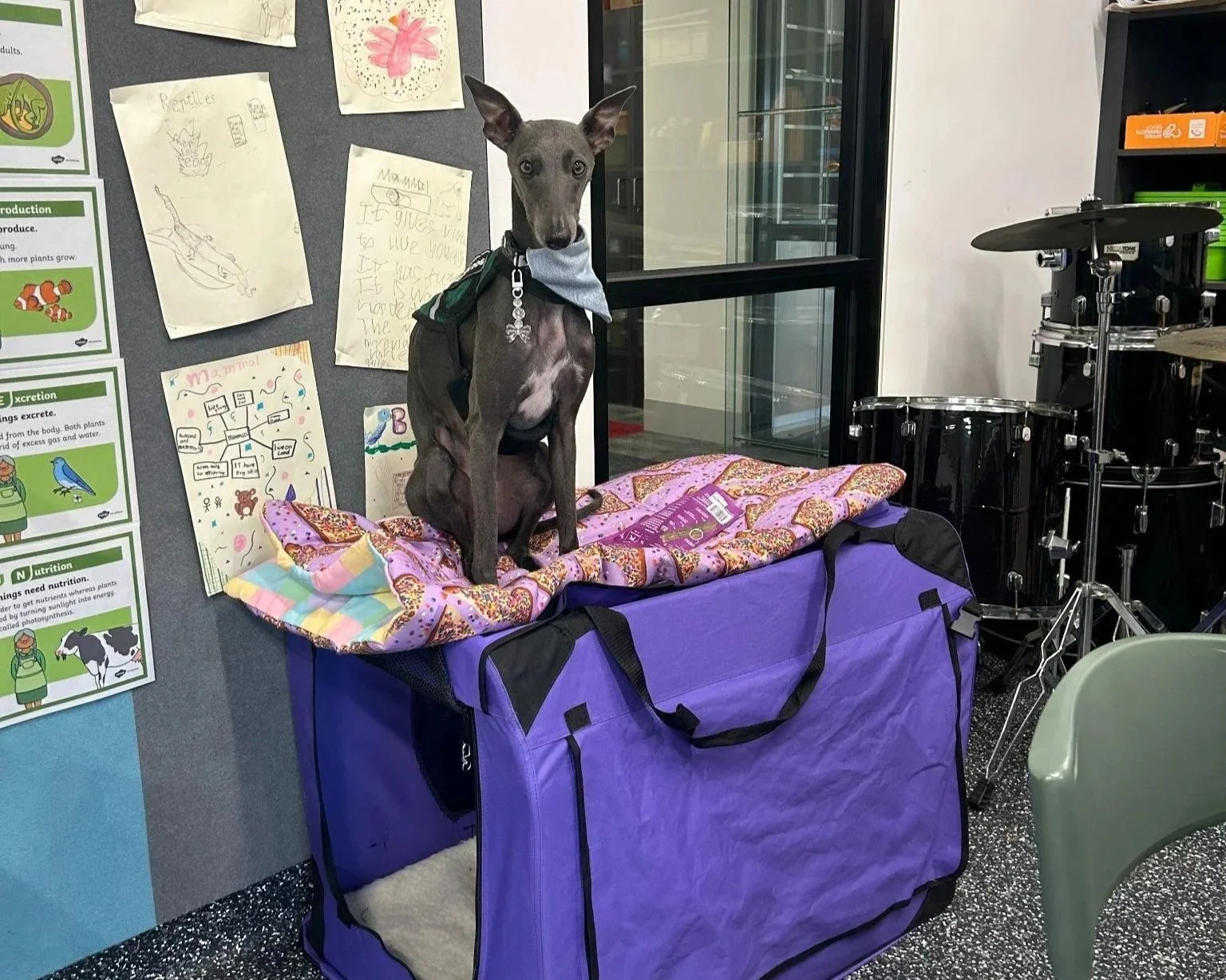
Occupational therapy dog Zeena gives a glimpse of her playful personality. Handler Pippa Martin found adapting her training style to meet her sighthound’s needs was paramount to their successful partnership.
.
You created a very comprehensive and affordable resource for activities to target a wide range of therapy goals, Bark to Basic (2025).
I know from having created AAT resources myself that the amount of time and effort to put something of this quality together is astronomical. What motivated you to dedicate yourself to this task?
When I first started integrating animal-assisted therapy, I found a lot of resources were either incredibly generic or heavily favoured the standard "retrieve a ball" mechanics of retriever-type breeds.
There was a massive gap in resources that combined robust, evidence-based Allied Health goals (fine motor, gross motor, sensory processing, regulation) with the actual reality of working with a dog's natural behaviours.
I wrote Bark to Basicto give therapists a concrete, practical guidebook. I wanted to show how a dog's everyday actions, from watching them rest to engaging in structured play, can be mapped directly to paediatric therapy goals.
My goal is to empower other interventionists to think outside the box and realise they don't need a stereotypical breed to do impactful AAT work, but also to relieve some of the mental load of planning sessions!
Planning and prep take so so much time, and if Bark to Basic relieves even 5 minutes of planning for a session to me, that’s a win.
(Pippa even offered a discount! Use coupon code SPEECHDOGS at checkout for 25% off.)
What’s next for you and Zeena in your animal-assisted occupational therapy partnership?
It’s a bittersweet transition time for us! Our school-based program has officially concluded now that the grant funding has wrapped up, which was an incredible chapter. But as one door closes, a massive one is opening: I am officially launching an occupational therapy practice, Planet Ability, this July 2026!
With the launch of Planet Ability, we are massively expanding our therapy dog program. We are moving out of the classroom and into dedicated, individual OT sessions three days a week.
We’ve found a beautiful new home base in Warrandyte (Victoria, Australia) set on 2.5 gorgeous acres. Having all this space means we have endless outdoor opportunities for therapy—think regulation walks, sensory exploration, and gross motor play.
Plus, Zeena is officially upgrading her work schedule from one day a week to three. She absolutely loves her job, so getting to partner with her three days a week is going to be so much fun for both of us and the kids we support!
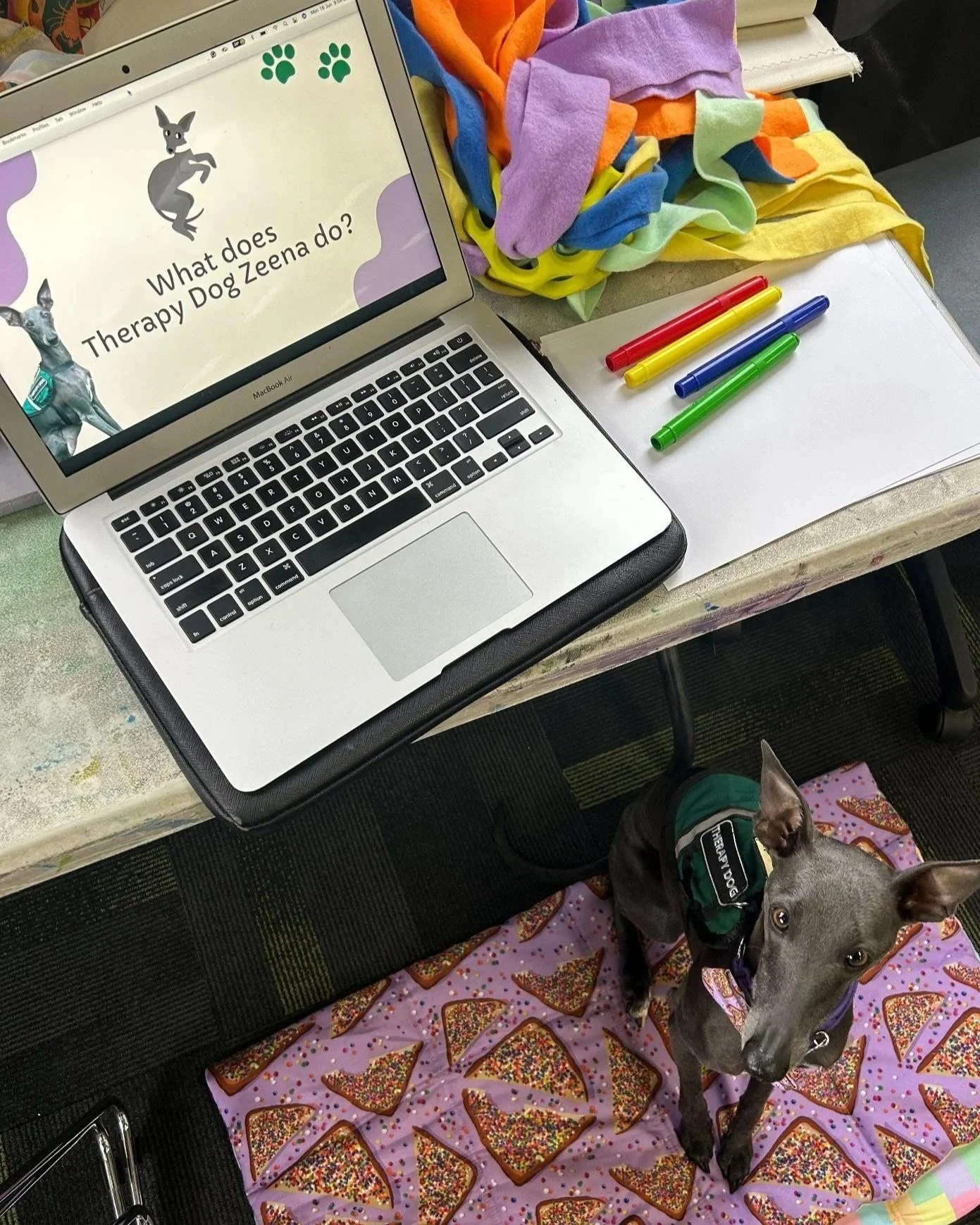
Therapy dog Zeena with a peek at the book she helped inpire, Bark to Basics.
This comprehensive resource of animal-assisted occupational therapy activities is available here.
(Use coupon code SPEECHDOGS for 25% off.)
Finally, with all your dedicated experience handling a therapy dog, what’s your biggest advice for a professional looking to get started in this niche?
My biggest piece of advice is to throw out the rulebook on what you think a therapy dog is supposed to look like and focus entirely on the connection.
First and foremost, non-traditional breeds are absolutely okay. Don't feel pressured to get a classic breed; look at the individual temperament, drive, and sensitivity of the specific dog in front of you.
Once you have your partner, crate training is an absolute lifesaver. It is essential for managing session flows and, above all, guarantees a built-in safe space where your dog can rest and remain safe when they need a break.
Always work with the dog in front of you rather than forcing them into a rigid box. If they are tired, sensitive, or just not feeling a specific interaction, respect their boundaries.
Finally, remember to have fun! Getting to take your dog to work is an incredible privilege, and it brings pure joy to your clients.
But be realistic: don't expect sunshine and rainbows every day.
Your dog can, and absolutely will, completely derail a session at some point. Incorporating an animal means you have to learn a whole new set of clinical adaptation skills on the fly but when it clicks, there is nothing better.
Pippa, I absolutely love how you’ve followed your heart and found a unique dog that not only suits your work but also your personal lifestyle.
Your emphasis on treating Zeena as an individual and seeking ways to train and manage her comfort based on her specific needs is fantastic.
Your observations of how she helps your clients find intrinsic motivation echoes what I see in my animal-assisted speech therapy practice every day.
And I highly recommend people check out Bark to Basics for AAT ideas, regardless of their specific field.
I can’t wait to watch your practice grow as I continue to follow the adventures of “cheeky” little Zeena, ambassador for the Whippet breed and therapy dog extraordinaire!
May your day be filled with puppy wiggles and children’s giggles,
Sharlet
Related articles:
Dear Delta… Lessons Learned About Animal-Assisted Speech Therapy (working with an adopted adult dog)
Johnny Utah’s Story: What My Ever-Wiggling Brittany Taught Me About Animal-Assisted Speech Therapy
My Firecracker: Lessons from Sky’s First Year as a Speech Therapy Dog
Puppy Love and Selecting a New Speech Therapy Dog: Zephyr’s Story