Last week, Dr. Kristina Spaulding of Science Matters LLC reminded us that when it comes to canine resilience, the answer is often "it's complicated."
She helped unpack the interplay of genetics and environment and what research really says about puppy raising, temperament testing, and selecting dogs for a job.
One theme surfaced again and again: there are no simple formulas, but there are evidence-based ways to stack the odds in our dogs’ favor.
While choosing the right dog is an important first step, it's only the beginning. A therapy dog's long-term success depends just as much on the experiences, training, and assistance they receive throughout their career.
So this week, we'll shift from selection to on-going support as Dr. Spaulding shares practical training and handling strategies that can help therapy dogs thrive throughout their working lives…

Dr. Kristina Spaulding, Ph.D., CAAB, with her Beagle mix Darwin.
Dr. Spaulding is an expert in canine well-being and author of The Stress Factor in Dogs: Unlocking Resiliency and Enhancing Well-Being.
If you click a link it may be an affiliate link and I will earn a small commission. It doesn’t cost you anything extra. If I don’t love a product, you won’t find it here!
Sharlet: We hear a lot of about the importance of socialization, yet there don’t seem to be a lot of firm guidelines around what does or doesn’t constitute quality socialization.
I love that you define socialization as simply, “learning to cope with novelty.” What advice can you give about socializing young dogs.
Do you see the need for any significant difference between how you socialize a young dog getting a fresh start in the world versus an adult dog being rescued from a shelter or foster system?
Dr. Spaulding: Yeah, socialization is another area where we need more research. Again, there are some things that we do know.
One thing I will say is that I do not believe the socialization window closes at 12 weeks. Early life experiences have a larger impact on behavior than events that occur later in life. This is because animals have more flexibility during early development. The same experience is likely to have a bigger impact, on average, during early life than it would later on.
What I think we don't know is exactly where those boundaries are. The number that gets thrown around most often is 12 weeks, with the claim that this is the end of the socialization window.
That idea is based on very old research conducted in a laboratory environment that only examined certain aspects of development. A single study can never give us a full picture of behavior and I am not convinced by that research that 12 weeks is the correct cutoff point.
Based on both anecdotal experience and the limited research we currently have, I would say that we definitely want to start socialization prior to 12 weeks, and we definitely do not want to stop at 12 weeks (emphasis added).
In terms of what good socialization looks like, it is not simply exposing a puppy to as many different things as possible. We must pay close attention to the puppy's ability to cope with those experiences. If the puppy is frightened, trying to escape, trembling, or becoming very still or disengaged from the environment, then what we may be teaching them is that new things are unsafe or overwhelming.
Instead, we want to teach them that they can cope with novelty, that they have some control over their environment, and that the people around them are trustworthy. That means carefully exposing them to new experiences in a gradual way, making sure they can opt out or avoid those experiences if they choose, and providing comfort when they seek it (emphasis added).
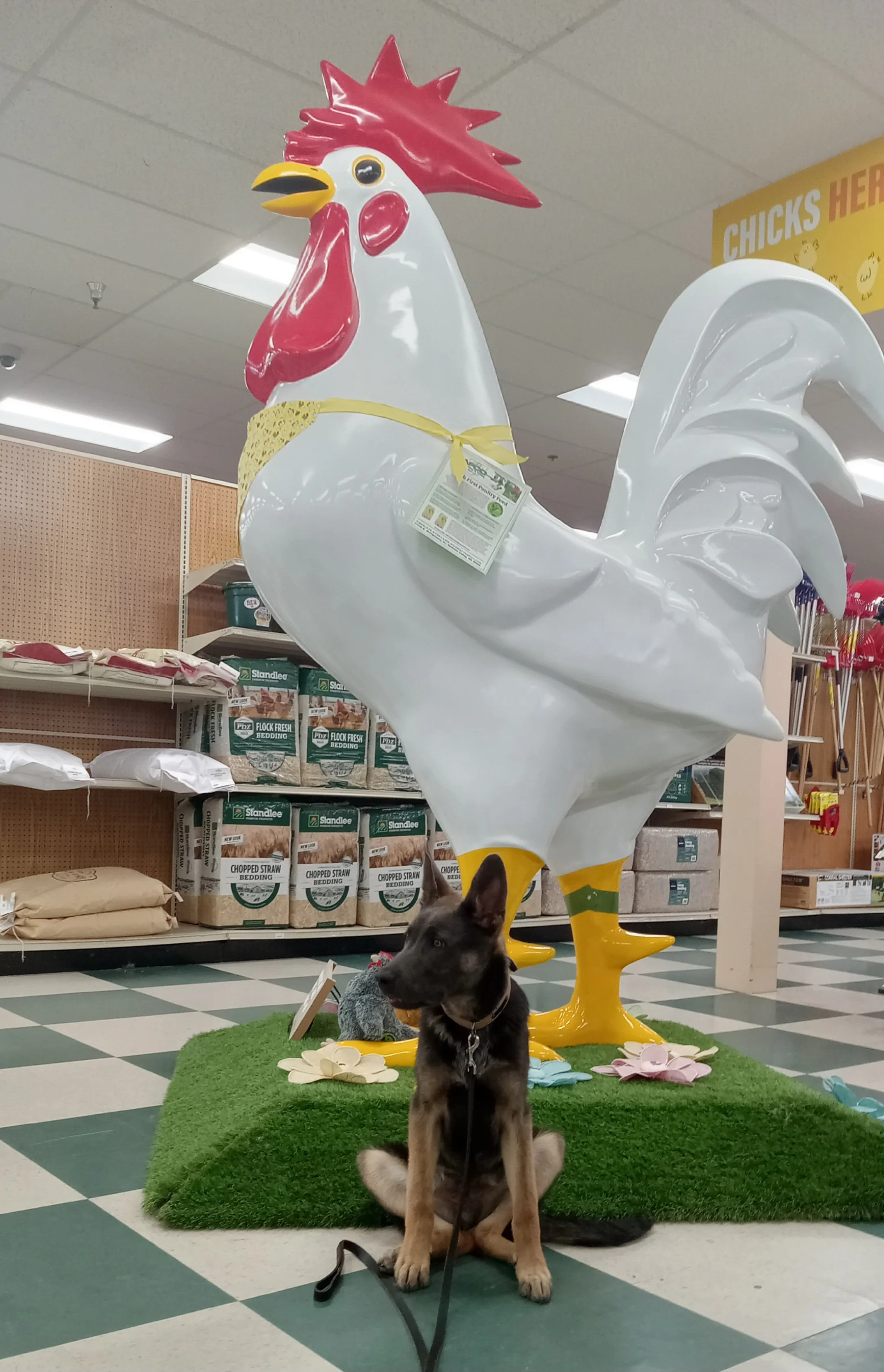
Of the most fun—and hardest—parts of bringing a puppy into your life is providing socialization.
Here future speech therapy dog Zephyr explores a local feed store as part of our twice weekly puppy socialization outings.
It is very important that puppies learn that we will provide safety and comfort when they ask for it. It may seem a little counterintuitive, but that support can help them become more independent later on.
When I talk about providing safety and comfort, I do not necessarily mean picking up the puppy, coddling them, or protecting them from every potentially negative experience.
But if they come to you, jump up on you, or choose to stand near you, we do not want to force them away. We can provide reassurance through our presence, our tone of voice, and gentle physical contact and allow them to stay close to us.
At that point, we need to make a judgment. Does this puppy simply need more time to process the situation, or is this experience too overwhelming? If it is too much, then we need to back off and try something less intense later.
One skill I’ve found incredibly helpful when supporting my therapy dogs in their work is recognizing and reinforcing—whether through quick praise or a small food reinforcer— the “auto check-in,” yet it doesn’t seem to be routinely taught in obedience courses. (To see a quick video example, click here.)
Can you explainauto check-ins and the benefits you see in working on them?
Yes, I love auto check-ins. I have so much to say about this, and I'm so glad you asked this question.
First, let me explain what I mean by an auto check-in. To me, it's a kind of uncued offer of attention from the dog. The reason I say "kind of uncued" is that when I initially train this behavior, I typically stand still in one place and wait for the dog to look at me. Standing still and not interacting with the dog is actually an environmental cue. However, over time, dogs will often begin initiating the behavior on their own, and in that sense it becomes uncued.
So, what we're doing is waiting for the dog to make a decision to disengage from the environment and look at us (emphasis added).
The reason I think this is so beneficial is that, in my observation, it seems to be connected to the dog learning to regulate both their emotions and their attention in busy or stimulating environments.
When I say "stimulating," I mean environments with a lot going on that grabs the animal's attention. What that looks like will depend on the individual.
Some dogs may find a quiet but unfamiliar environment very stimulating, while others can function comfortably in much busier settings.
What’s important is that the dog makes the decision on their own to disengage from the environment and orient toward their person.
To be honest, it’s not that important that they look at a person. What is important is the ability to disengage. I don't want dogs to get stuck staring at something or become hyper focused on a particular stimulus.
I want them to reach a point where they are comfortable enough and emotionally regulated enough that they can move on. In other words, they can decide, "Okay, this is not something that requires a strong, prolonged response."
Again, the way I teach this is simply by standing still and waiting for the dog to look at me.
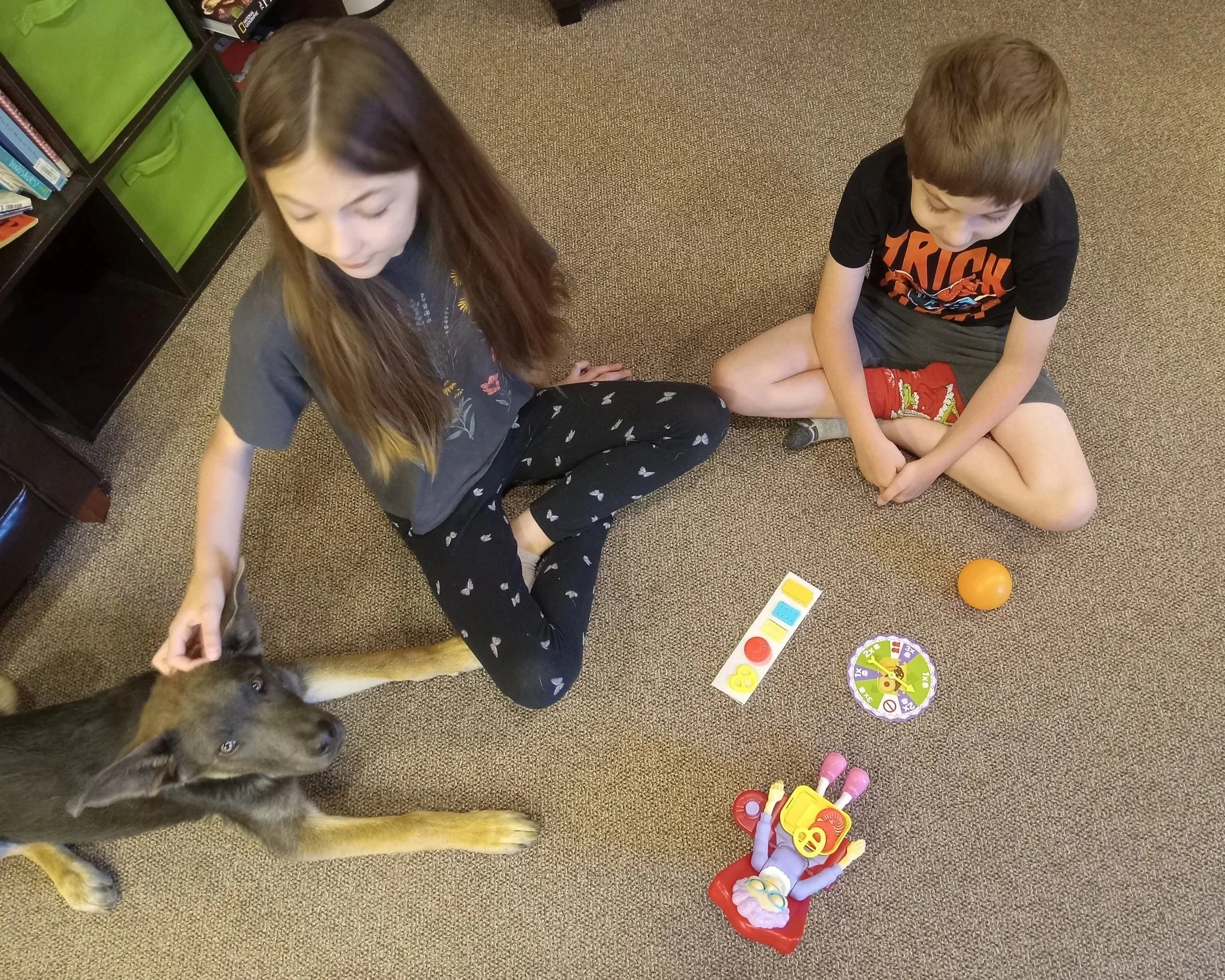
As a young pup I scheduled special sessions with families to expose Zephyr the games and materials of a typical speech therapy session.
Here Zephyr looks to me (Sharlet) in an auto-check-in when Greedy Granny pops awake.
I want to mention something else here that I think is connected to several of the other questions you've asked and is particularly relevant for therapy dog work and animal-assisted interventions. I feel pretty strongly about this, although we do not have direct research on it. My thinking is based on observation and research that is indirectly related to these issues, including agency, emotional regulation, and exposure to novelty.
I think it is really important, especially for young dogs, that when we are out in the world with them and they need to stop and investigate something, we allow them to do so (emphasis added). That investigation may simply involve standing still and watching something from a distance.
My hypothesis is that when we do not allow dogs to investigate novelty on their own terms, we take away an important opportunity for learning (emphasis added). They don't get the chance to gather information, decide something is safe, and then move on. If we simply keep them moving—whether by dragging them past the thing or using food to lure them away from it—they never get to determine for themselves that it is safe.
As a result, they may move through the world encountering all sorts of things they are uncertain about, but without and the ability to resolve that uncertainty.
Over time, they may accumulate a growing list of stimuli that seem potentially threatening because they have never had the chance to gather enough information to feel comfortable with them.
I think that's another really important component of socialization. When it is safe and appropriate to do so, we should give dogs the opportunity to investigate things that concern them–on their own terms.
Sometimes those things seem completely mundane to us. My administrative assistant recently moved a statue in her yard, and her adolescent dog was completely freaked out by it. The statue had been there for essentially the entire time he has lived there, but moving it changed how he perceived it.
She allowed him to investigate, and he was able to work through it and move on.
This kind of thing happens on walks all the time. Sometimes dogs simply need to stop and watch the world for a while. They need an opportunity to reassure themselves that they are okay and that the things they are seeing out in the environment are okay too.
I think most professionals in health and education have a good understanding of learned helplessness, but until exploring your resources I had not heard the term “learned industriousness.” Can you explain what this is and what we as handlers can do to encourage it in our dogs?
Related to that, giving a dog agency is highly emphasized within the animal-assisted therapy world. How exactly does agency actually improve a dog’s ability to handle novelty and their overall well-being?
Learned industriousness refers to animals learning that what they do matters and that it is worth continuing to try until they find a solution.
It is kind of the opposite of learned helplessness. I say "kind of" because, again, these are complicated phenomena and not completely black-and-white opposites. However, they are different ends of the same spectrum.
With learned helplessness, animals learn that their behavior doesn't matter, so they stop trying. With learned industriousness, they learn that their behavior does matter, so they continue trying until they find a solution.
That sense of agency is strongly connected to increased resilience and an improved ability to cope with stress.
One way we can support this is by giving animals opportunities to solve problems on their own when it is safe and appropriate to do so.
For example, a dog's ball might bounce into an empty bucket, and they have to figure out how to get it out. If the dog is completely freaked out by the bucket, won't go near it, sits down, and gives up, that doesn't mean we simply stand back and do nothing. Maybe we need to put the bucket on its side or place the ball next to the bucket so the dog can be successful.
What we want to do is create a tiered set of small challenges that are matched to the dog's abilities.
We want to provide small challenges that they can succeed at relatively easily and quickly, especially in the beginning. That allows them to develop these coping skills over time.
Then, when they encounter genuinely difficult situations—which we don't need to create, because life will inevitably provide them—they will have a history of successfully navigating smaller challenges that can help them cope with the larger ones (emphasis added).
As we continue to provide opportunities like this, their ability to engage with novelty and persist through challenges should improve.
In turn, that should improve their ability to cope with stress.
Agency gives animals opportunities to make decisions and navigate situations on their own so they can practice for future challenges. Through those experiences, they learn that their behavior matters and that they can influence outcomes.
Again, these challenges cannot be overwhelming. There are absolutely situations where we should step in and help, or simply remove the animal from the situation because it is too much.
Making sure that the challenge is appropriately matched to the dog's skill level is very, very important.
I like how you emphasize in your teaching that providing “enrichment” is only beneficial if your dog’s life is actually enriched by the item or activity—just providing access isn’t enough.
What are some examples of enrichment the average dog owner can incorporate into their dog’s life and what factors do you consider when deciding what enrichment to provide?
I'm going to go with sniffing here because it's a common form of enrichment, but also a very important one.
Giving dogs opportunities to sniff can take many different forms. It can be something more structured, like scent work, which can be as simple as hiding treats in boxes and letting the dog find them. When I get chews for my dogs, I will often hide them around the house and let the dogs search for them. They absolutely love that game.
It can also be something as simple as taking dogs for walks and allowing them to spend as much time sniffing as they want. Or you can divide walk time into different purposes.
Right now, I have a 13-year-old Beagle mix who has always loved sniffing. He's also slower than he used to be, so I can't really get meaningful exercise while walking him anymore. What we often do is take him for his walk and then go on a second walk separately where we're moving faster and going farther. During his walk, it may take us 30 minutes to go a quarter of a mile, and that's okay because it's his walk.
Another example related to sniffing is allowing dogs to investigate the boxes that come into the house. Ironically, my Beagle doesn't care much about this, but my Australian Shepherd absolutely loved it. It became one of his favorite activities. He wanted to watch (or help) me unpack the box, sniff everything that came out of it, and be involved in the whole process.
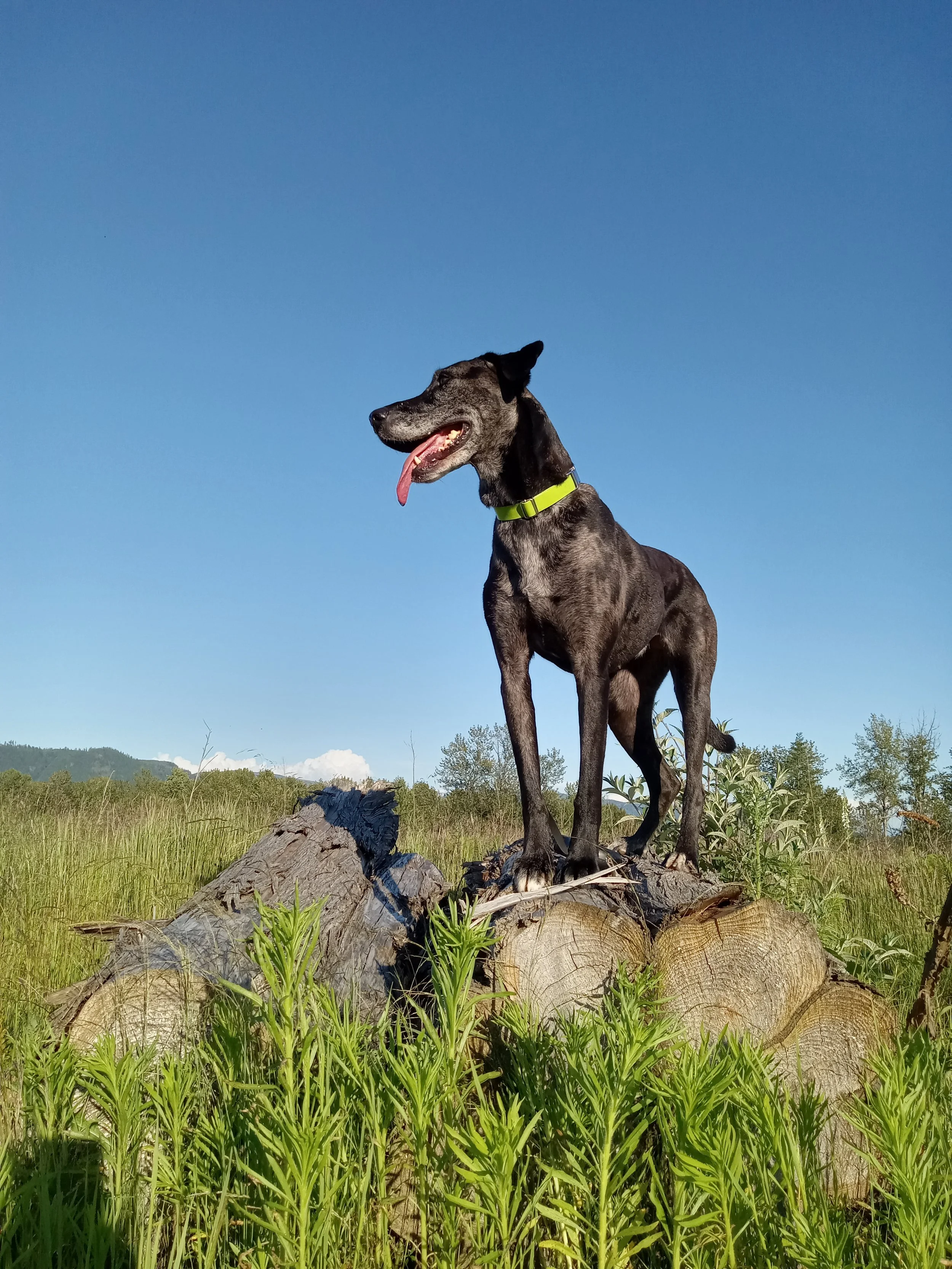
One thing I (Sharlet) have always prioritized is getting my therapy dogs for a walk to decompress.
Letting Delta sniff whatever she wants and choose the path (within reason) has been a great way for both of us to unwind after a long day of animal-assisted speech therapy when the weather and daylight allow.
I also let him tear up the boxes, which can also be enrichment. There is a risk to that, of course, because dogs may then decide that all cardboard boxes are fair game. For me, that was an acceptable tradeoff, but you certainly don't have to let dogs destroy the boxes. Even without that part, he loved inspecting the box and everything inside it. For him, this became a highlight of his day.
That's one of the things I like about enrichment: it doesn't always have to be complicated. Sometimes the most meaningful enrichment opportunities are very simple (emphasis added).
Other forms of enrichment can include taking dogs to new places, provided those places are not frightening or overwhelming for them, and engaging in positive reinforcement training.
I recently audited your “big course” on Unlocking Resilience in dogs and was blown away with the depth of content you provided on a wide array of topics related to canine well-being.
Can you tell us a bit about the resources available through Science Matters? What would be a good starting point for a therapy dog handler interested in taking a deeper dive into this topic? Would your resources apply to professionals partnering with other species as well?
Yes, thank you for asking! There are several different options, but I think there are two particularly good starting points for therapy dog handlers.
The first is a self-paced course called Science of Fear, which is exactly what it sounds like. It's all about what fear is, how it develops, and how we can work to minimize and address fear in our dogs. This course is a fairly deep dive into the science, but I make it accessible for people who are just getting started. We begin with the basics and build from there.
I think the Science of Fear course is a really nice starting point whether you're an animal professional or not. It's also applicable to other species, not just dogs.
The course is currently going through a remodel and will be released in a much nicer and, I think, more user-friendly format soon. However, anyone who purchases it now will automatically receive access to the updated version when it is released. So, if you're excited to get started, you can purchase it now without worrying about missing out on the new version.
The second course I would recommend is Unlocking Resilience, which is a 16-week deep dive into all things related to resilience.
We start by talking about stress, then move into cognition and emotion and how those processes influence behavior. From there, we explore resilience itself—what makes some animals more resilient than others and how we can help promote resilience in the animals we work with.
We also spend time looking at research on mental health in humans, much of which draws heavily from rodent research, and discussing how some of those findings may be relevant to our work with animals.
Throughout the course, there is a huge emphasis on application. We spend a lot of time discussing how to take this information and use it in the real world with the animals we work with. UR is also applicable to all species (at least all mammals), not just dogs.
In general, all of my courses are very science-focused, but there is always a strong emphasis on translating that science into practical applications. A major theme throughout my teaching is asking, "How do we take what we know from the research and apply it to the work we're actually doing on the ground?"
Wow, so much great information to digest here!
I’d like to give Dr. Spaulding a big thank you for tackling some difficult questions so that we can all help ensure our therapy dogs live the best possible lives.
May your day be filled with puppy wiggles and children’s giggles,
Sharlet
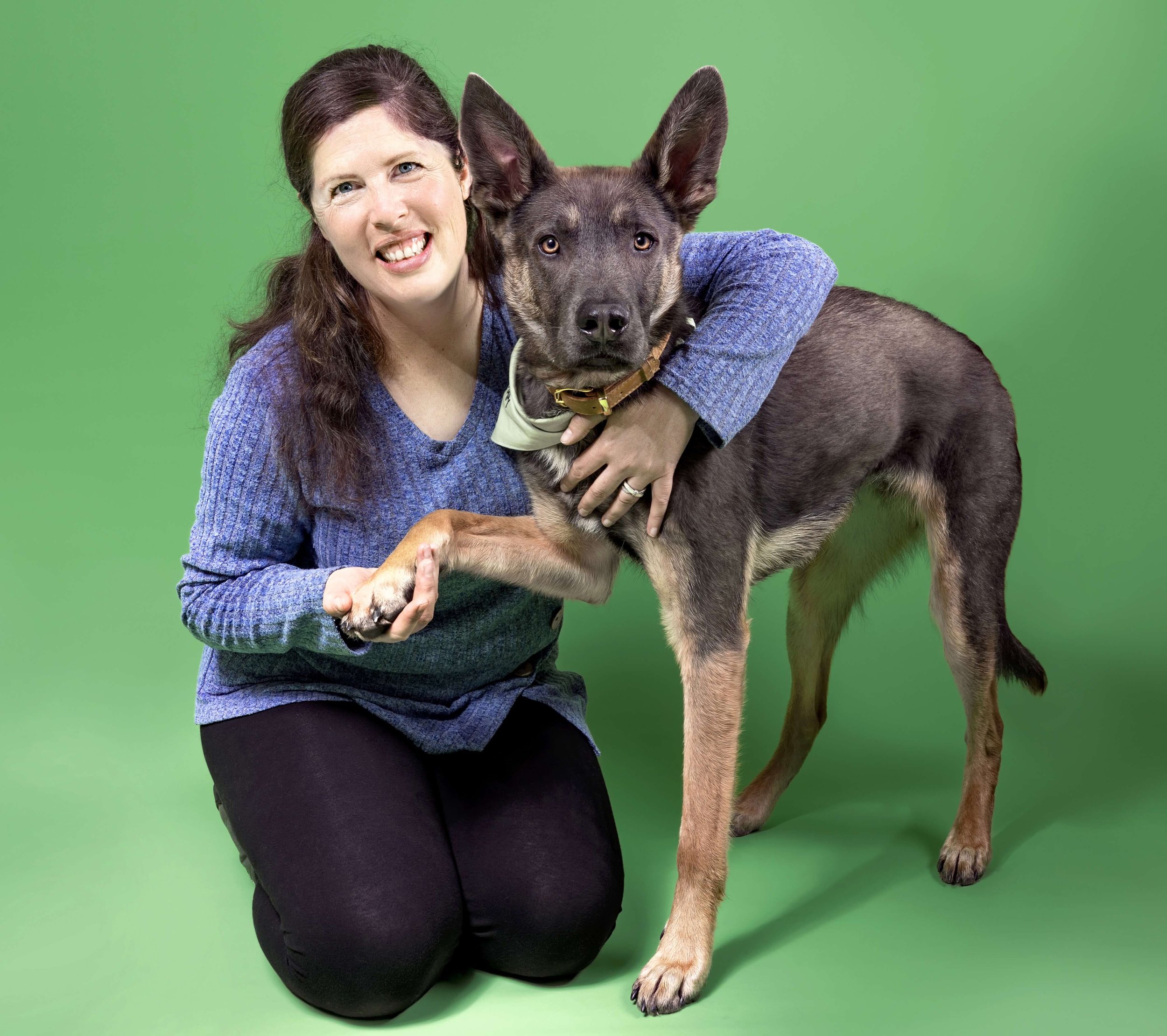
Update: I (Sharlet) recently used the 16 hours of Dr. Spaulding’s Unlocking Resilience as continuing education units to maintain my Certified Animal-Assisted Intervention Specialist (C-AAIS) through AAAIP!