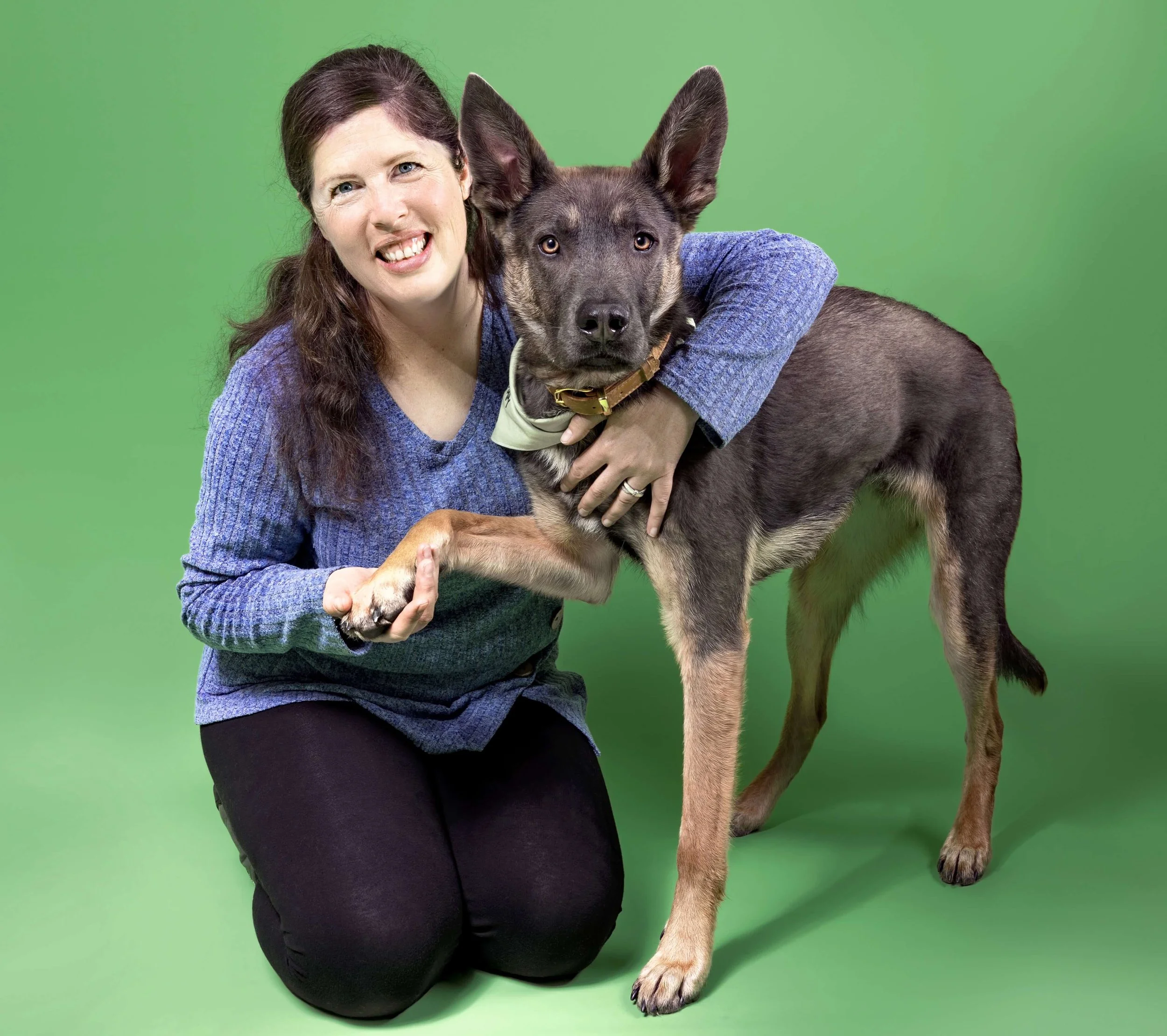
Listening to Zephyr: Building Social Cognition Through Animal-Assisted Speech Therapy
“What is Zephyr’s body language saying?”
It’s a common refrain during my sessions.
Many of my child clients have difficulty with social cognition, understanding another person’s perspectives and intentions.
Sometimes it’s the primary reason they come to see me, but often it’s a subtle yet nonetheless pervasive challenge that leads to frequent conflict with peers and family members.
With a background as an autism specialist and consultant, I’m often the first to pinpoint this difficulty for families.
So despite the specific communication goals I’m addressing with a particular child, I often find myself weaving in opportunities to practice social cognition to better a child’s overall functioning within society.
Here’s four ways my therapy dogs are especially helpful in this area…
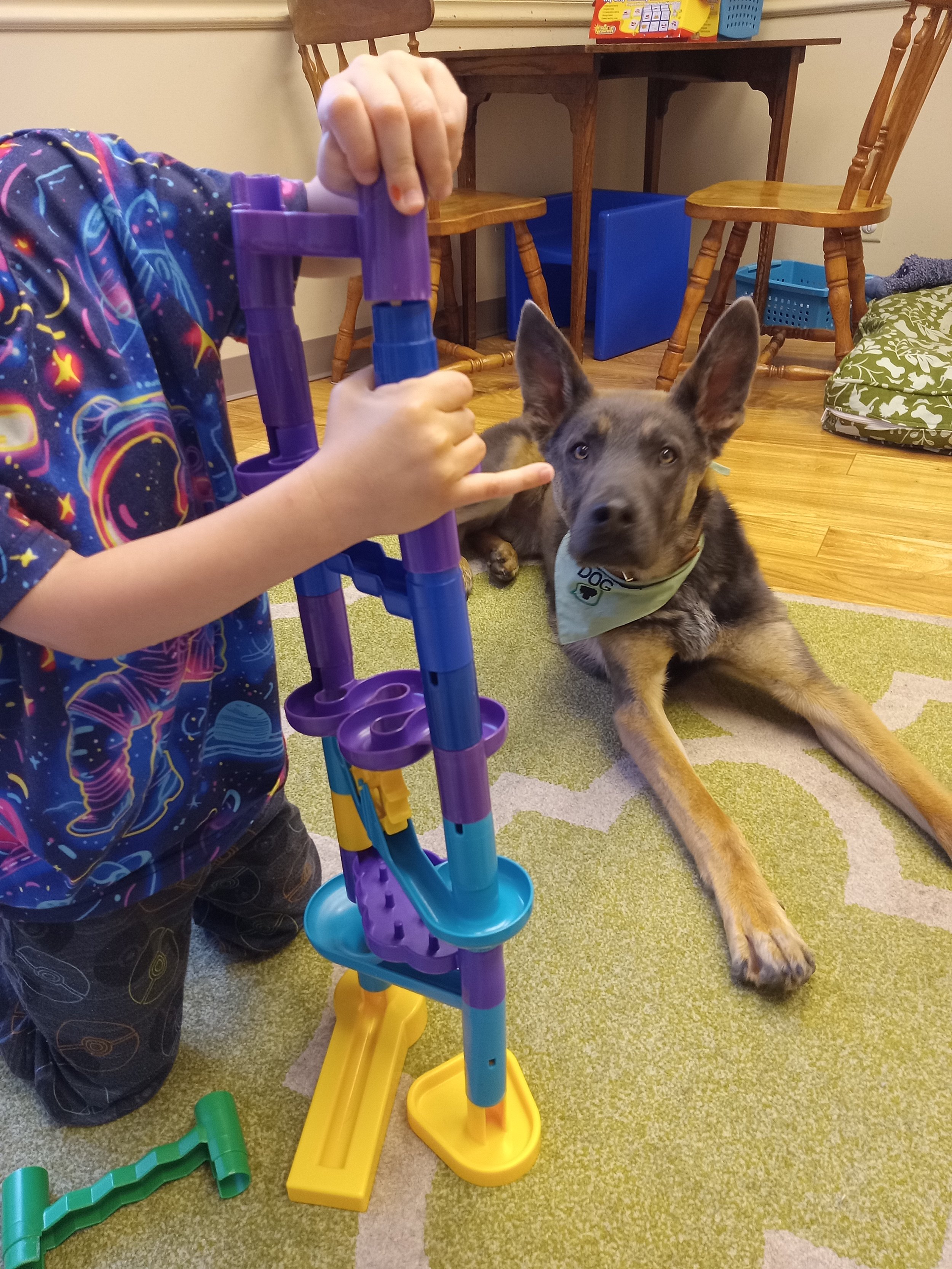
Checking in with a dog’s body language can be a great way to broach social cognition skills with kids who are averse to talking about peer interactions.
Here Zephyr shows us he is ok with the commotion of a noisy marble tower by leaning towards it with a relaxed expression.
If he had been leaning away we could problem-solve what to do differently to keep him comfortable.
If you click a link it may be an affiliate link and I will earn a small commission. If I don’t use and love a product you won’t find it here!
#1. Recognizing the impact of bodily proximity from a therapy dog’s reactions
I often find that directly discussing a child’s actions results in an immediate fight of flight response, with the child either avoiding the topic altogether or becoming defensive and irritated.
At that point, not much learning occurs and my rapport with that child is threatened.
When I can bring in a dog as a neutral third party though, kids are often much more willing to talk through a scenario and practice new ways to interact.
Here’s a few ways that can look:
When a child tends to intrude into others’ personal space, we practice noticing when the dog moves away in response, generate ideas of what they might be thinking, and practice alternative ways act near them.
Admittedly, the dogs vary a lot in how helpful their reactions are.
Delta in particular is very confident and used to kids acting a bit wildly, so she doesn’t react much when kids bump into her or move too fast.
Sky, on the other hand, is more self-protective and quick to jump away if she’s worried about being crashed into, understandable given her smaller size. Sometimes this really gets a kids’ attention but other times it triggers frustration.
So far Zephyr seems to be my most helpful in teaching this skill as he leans away slowly, giving a clear response without seeming overly stressed.
When a child tends to just walk away in the middle of an interaction, we discuss (often by co-creating a comic strip conversation) how the dog feels lonely and sad because his friend isn’t paying attention to him. Then we can generate alternatives, such as using a carrier phrase (e.g., “let’s go to…”) or gestures to encourage the dog to come along for a “walk and talk.”
To help with generalization to other humans I try to model and teach gestures we use (e.g., waving an arm for “come on”) instead of dog-centric actions like patting a leg. Sometimes I’ll put my dog on a leash to better ensure the dog responds ideally to a child’s efforts.
When kids just don’t register that they are walking faster (in my experience it’s rarely slower) than those around them, I teach them to check in with their eyes to see that they are staying roughly shoulder to shoulder with their walking buddy.
I’m often amazed at how difficult it is, even for my older clients, to coordinate keeping a conversation going while turning their head slightly for these check ins. Fortunately we can get lots of practice while transitioning in and out of sessions or even making a dedicated trip to the dog’s potty area (with caregiver permission and assuming the child can act safely outside the office).
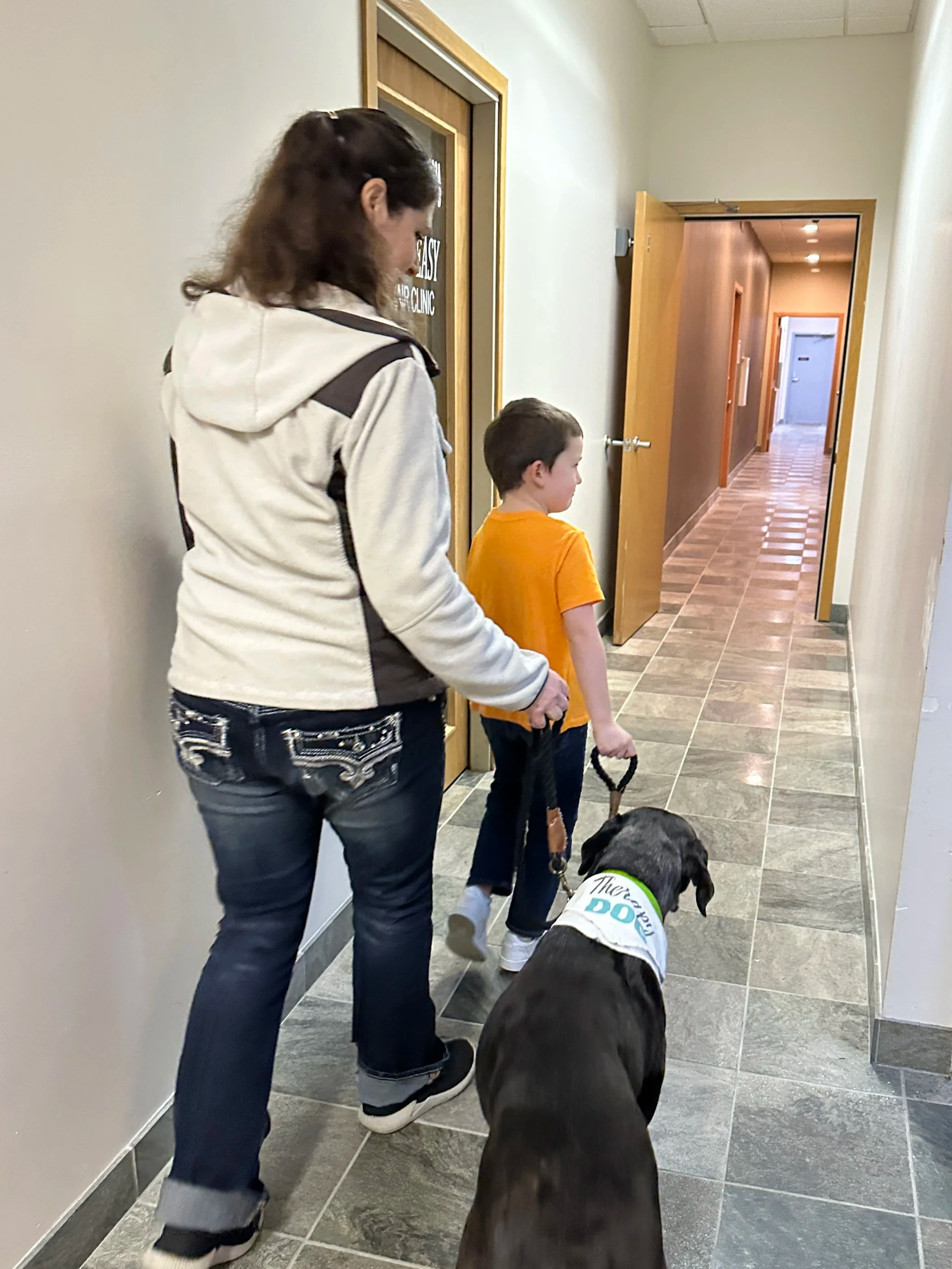
Practicing “walk and talks”—coordinating our speed and turning our head to check that Delta is still with us as we transition between spaces—is a fun way of embedding social cognition work into animal-assisted speech therapy.
#2 Discussing issues of consent and autonomy with a therapy dog
As part of their introduction to my dogs, I explain to new clients where each dog usually likes to be petted and what treats and toys each likes best. For some, it’s a quick one and done conversation.
For others, who may struggle with social memory and/or impulse control, it’s a frequently revisited topic.
Watching the dog’s body language is a huge part of this skill, and sometimes I’m amazed at how explicit I need to be.
For instance, Zephyr typically doesn’t mind having his feet touched while we sit on the floor together, even seeming to luxuriate in receiving a toe massage. (This is fairly unusual for dogs.) Some kids play with his feet almost like a fidget toy while they work to stay focused and Zephyr seems none the worse for it.
However he’s inconsistent on whether he wants his ears touched or not. The ultra soft, fine hair on his “fruit bat” ears are a true tactile temptation.
So we practice watching for any sign that he is moving away, staying in place, or pushing closer to ask for more. How he moves his feet is a very different action than the ear twitch, head turn, or look away he uses express displeasure with ear touches, and I have to clearly point this out.
Likewise we can discover if a dog moves closer, leans in, or has more relaxed facial muscles to indicate a desire for more interaction.
(Click here to see a video)
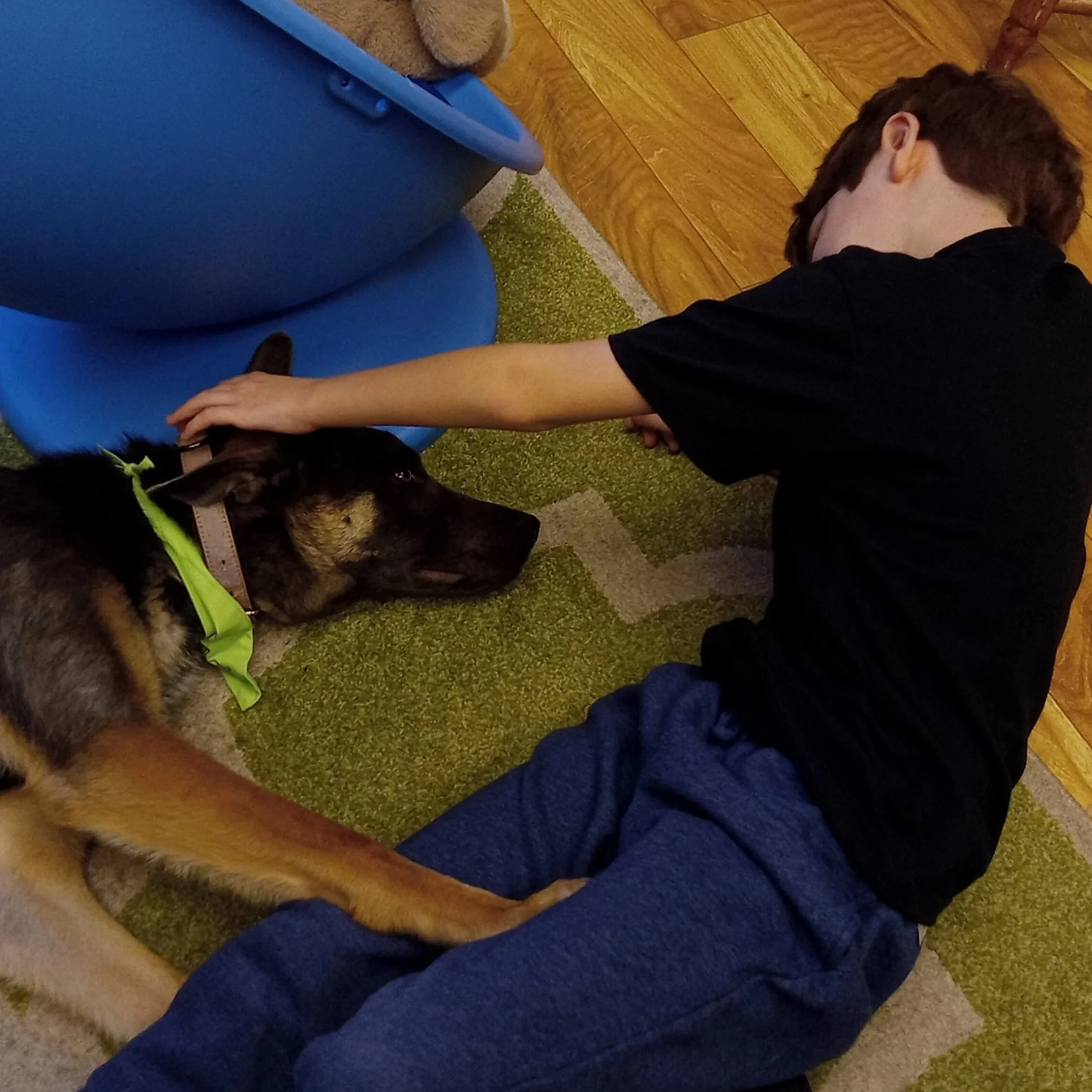
Watching therapy dog Zephyr for cues he wants more pets on this part of his body or would prefer a different spot is a skill frequently embedded throughout my animal-assisted speech therapy sessions, regardless of other communication skills we may be more specifically targeting.
I’ve also had a few kids that can be fairly demanding that the dog plays in a specific way. Sometimes they want to watch the dog chewing on an elk antler toy, other times they want to engage in a more active game of fetch.
The challenge is, the child’s desire doesn’t always match my dog’s desire in the moment. So we’ve worked a lot on presenting a toy and asking “Do you want to play with ____”, watching for a response (either taking the toy or looking away), and responding accordingly.
(to see a video of this, click here.)
For kids with more limited expressive language, it can also be a great way to practice asking questions like “Do you want ____?” in a highly meaningful and memorable context as well.
Making short videos that we can review together to examine the dog’s reaction in isolation can be really helpful, as well as allowing the child to “teach” the parent what the dog is saying later on.
This often stimulates conversations about interactions with siblings at home, so I’ve learned to allow a few extra minutes at the end of the session for this activity.
#3 Exploring greetings and approaches
I think this one can be huge not only for carryover to human interactions, but also to keep kids safe around other animals.
We often think of greetings as simply a spoken aspect, saying “hi” or making small talk. But a kid that effusively barges through the door and barrels right up to me and my dog can be overwhelming!
And over and over I’ve heard stories from the parents of these overly enthusiastic kiddos of dog bites and cat scratches. The combination of a fast, direct approach with a lack of recognizing if an animal is trying to move away or freezing up is a recipe for disaster for all involved, so this can be a life-altering skill to address.
Sometimes I have a child practice going back into the hallway and trying again with a more regulated energy level. Other times we co-create a visual support that I place on my office door before they arrive to prompt a mental check-in before entering. One child wanted a simple “stop” sign; another benefitted from a checklist of things to consider.
Pointing out my dog’s happier body language (full body wags, approaching with relaxed ears and face) as well as my calm/happy face and tone of voice helps reinforce the child’s effort to self-monitor their approach.
#4. Identifying facial expressions in dogs before in humans
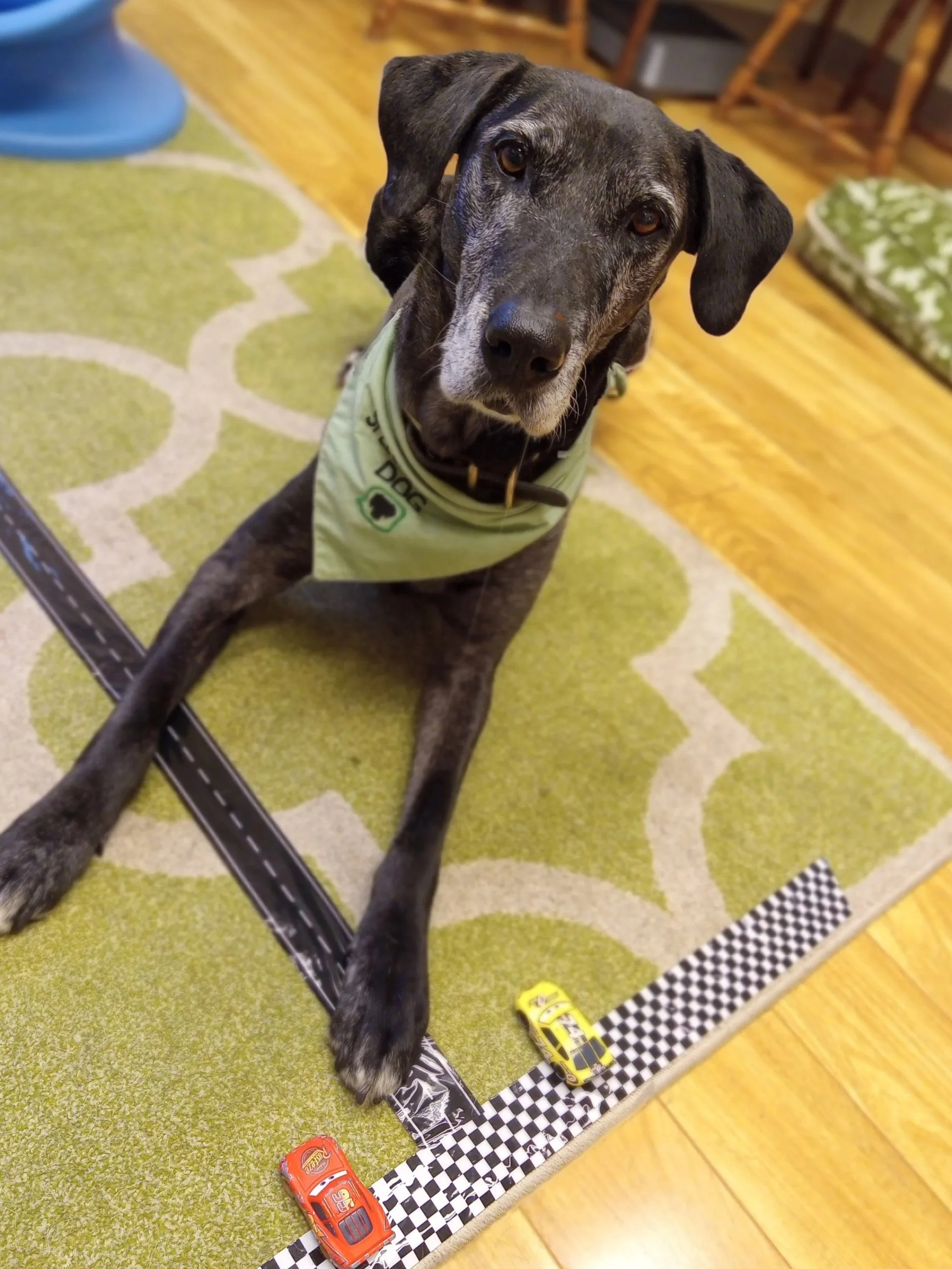
Speech therapy dog Delta demonstrating happy/relaxed body language during a play-based session. Her ears , eyebrows, and general body posture are lifting up and her jaw is relaxed giving a hint of a smile.
Don’t you love it when something you learn in one realm of your life carries over beautifully to another?
I recently started to work on emotional intelligence with an autistic middle-schooler but found he was very avoidantof the topic. Based on his comments I could tell this was a task that, while he still struggled with it, had been drilled to death at school.
So I wondered, could I take a lesson from the University of Denver Canine-Assisted Intervention Specialist course and tweak it a bit to better engage this boy in the learning?
Turns out, YES!
Taking the idea that humans and dogs perform similar basic movements with their facial muscles in response to big emotions, I grabbed some line drawings of Bolt the dog (from the 2008 Disney animated movie) that clearly showed the following:
Upward movements for happy (eyebrows up, midface up which crinkles the eyes a little, corners of lips up, head up tall on the neck)
Downward movements for sad (eyelids droop, corners of mouth turn down, head drooping a little)
Forward movements for angry (mouth puckers, eyebrows pinch together and the muscles bunch up forward, leaning forward)
Backwards movements for scared (mouth pulls back, body leans back)
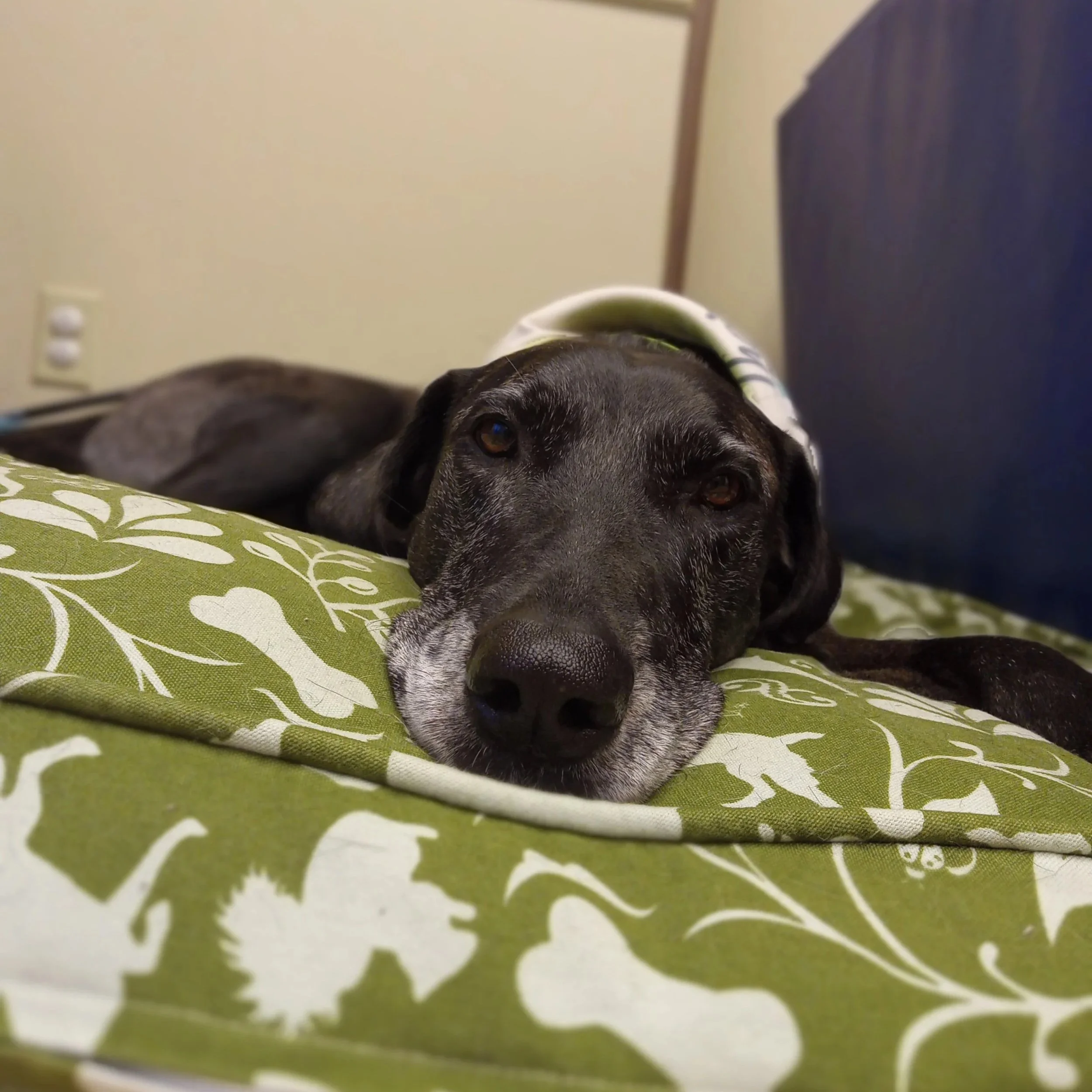
In sharp contrast to the previous photo, here therapy dog Delta shows lowered ears, eyes, and body. This was after a particularly stressful session and could be interpreted as sadness when teaching body language to kids with social cognition and emotional literacy challenges.
(This is based on information in the terrific Patricia McConnell book, For the Love of a Dog: Understanding Emotion in You and Your Best Friend; you can also check out her great presentation on the topic on YouTube here)
Yes, this is somewhat simplistic and a bit open to interpretation, especially when you get to more subtle emotions. But it was a place to start. And this boy was entranced! (as a bonus, he spontaneously tried imitating the facial expressions of Bolt and, with parent permission, I took photos to print out and refer to later).
As with many other social communication skills I’ve targeted with this boy and others, I suspect it’s often easier to for some of our neurodivergent clients to engage with animal-based materials because they don’t elicit the same fight-flight-fawn-freeze sympathetic nervous system response.
I suspect years of failed interactions with peers and adults provokes some degree of instantaneous anxiety, no matter how sensitively we try to broach these topics. And feeling stressed makes learning new skills much harder.
While this is a new activity for me, I’m excited by the engagement I’ve seen so far and look forward to trying it out with other kids.
Plus, since it’s an example of animal-related engagement, it doesn’t require my dog to actively participate or even be present.
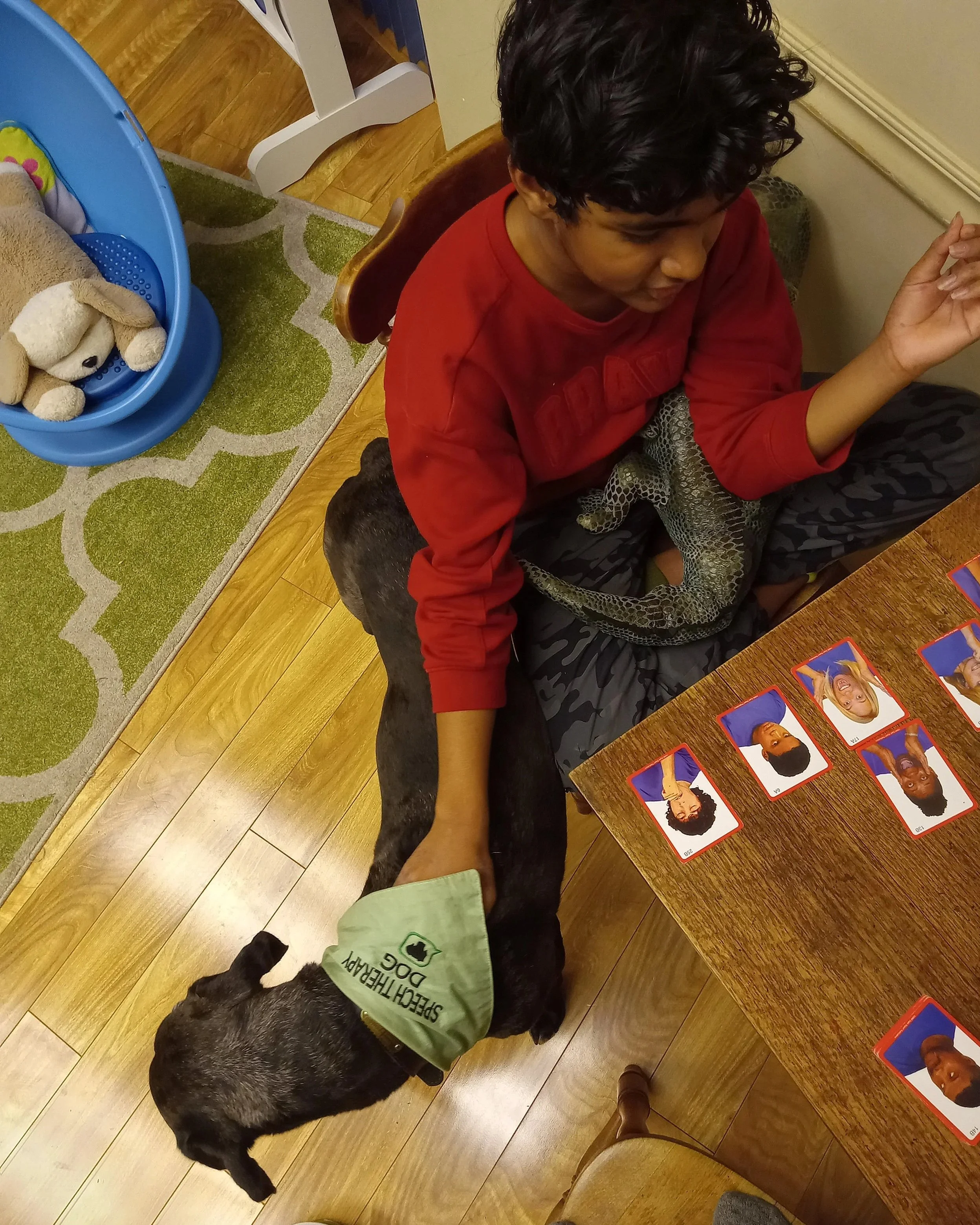
After examining photos of dogs and experiencing success identifying patterns in their facial expressions, this child was more willing to resume examining human faces in a structured emotional literacy lesson.
Therapy dog Delta remains close to help him stay calm and actively engaged.
Of course, an overarching priority of all this work is maintaining your therapy dog’s welfare.
While some stress in inevitable when working with kids who struggle to quickly recognize and respond to another’s feelings, we as handlers must do our best to minimize the times a child crosses the line.
Sometimes exploring an animal-themed book or video while your therapy dog rests on their bed is a more appropriate place to start, and at times I’ve had to just set a firm boundary that a child is simply NOT allowed to act a certain way around my dog.
All of these skills also help teach humane education, making the world a kinder place for all living beings.
To see more ways my dogs help me address a variety of speech, language, and literacy goals, check out the book Paws for Progress: Integrating Animal-Assisted Interventions Into Your Speech-Language Pathology Practice and the self-paced, online course Talk to the Paw: Foundations for Therapy Animal Inclusion in a Professional Setting. And follow on Instagram @Speech_Dogs to them in action.
May your day be filled with puppy wiggles and children’s giggles,
Sharlet