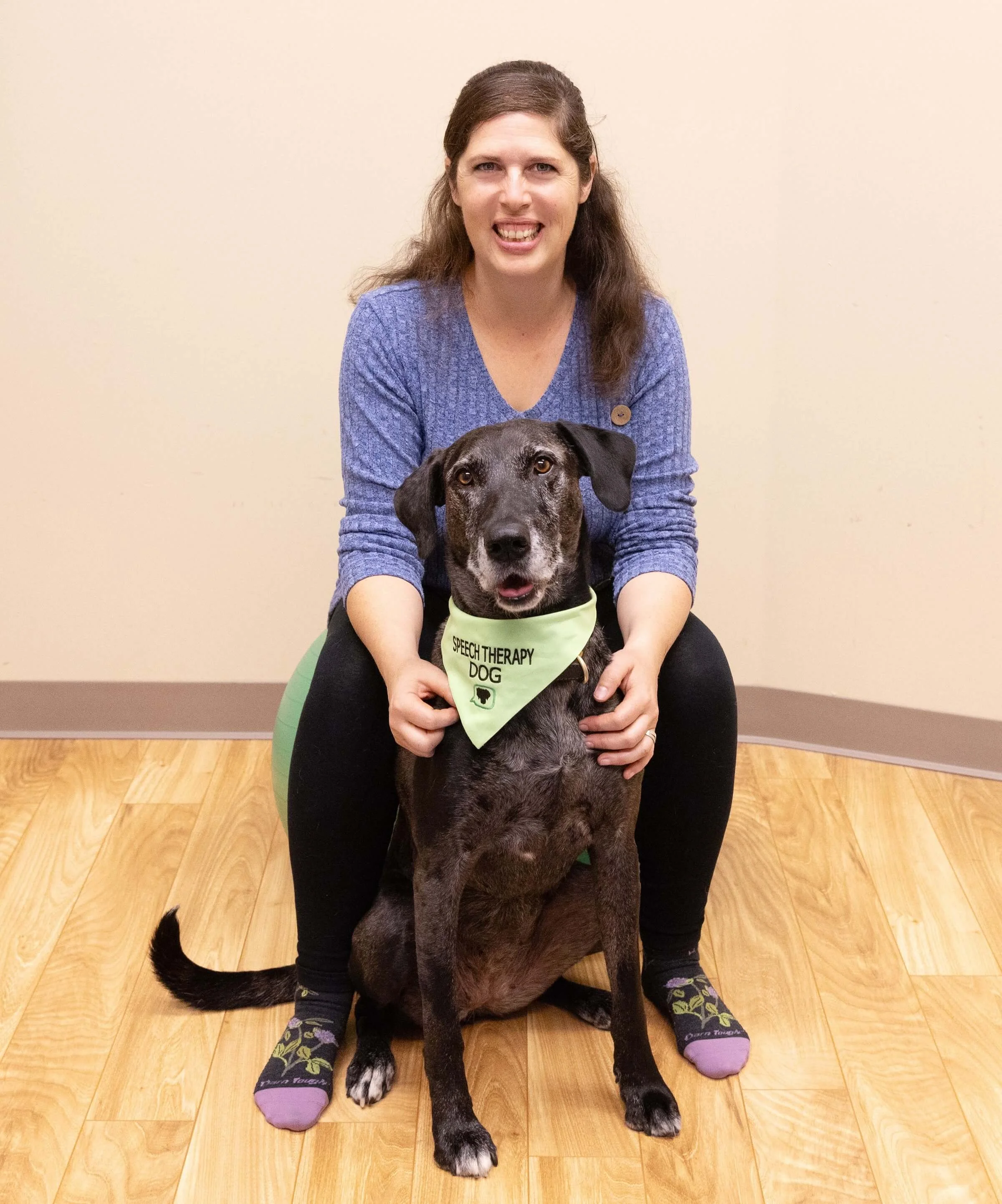
“She looks like Angry Birds! Say, ‘She looks like Angry Birds!’” the boy commanded as I was redirecting his hand from trying to wrinkle Sky’s forehead down over her eyes.
It was hard to believe that just a few months ago this same ten-year-old was hesitant to even touch my therapy dogs Delta and Sky.
Now he felt so passionate about playing with them that I had to be extremely vigilant to intervene before he innocently became too physical or directive with them.
This greater vigilance—along with increased responsibilities between clients, and an amplified opportunity for creative session planning—has made partnering with a therapy dog challenging in a way unlike I have ever experienced before.
Before the dogs I was used to problem-solving how to better support a dysregulated child or justify my services to an insurance provider from time to time, but this new professional challenge consumes each work day all day.
And that challenge is exactly why I love animal-assisted therapy!
Here’s a closer look at what makes partnering with a speech therapy dog difficult while simultaneously expanding my job satisfaction and skill set…
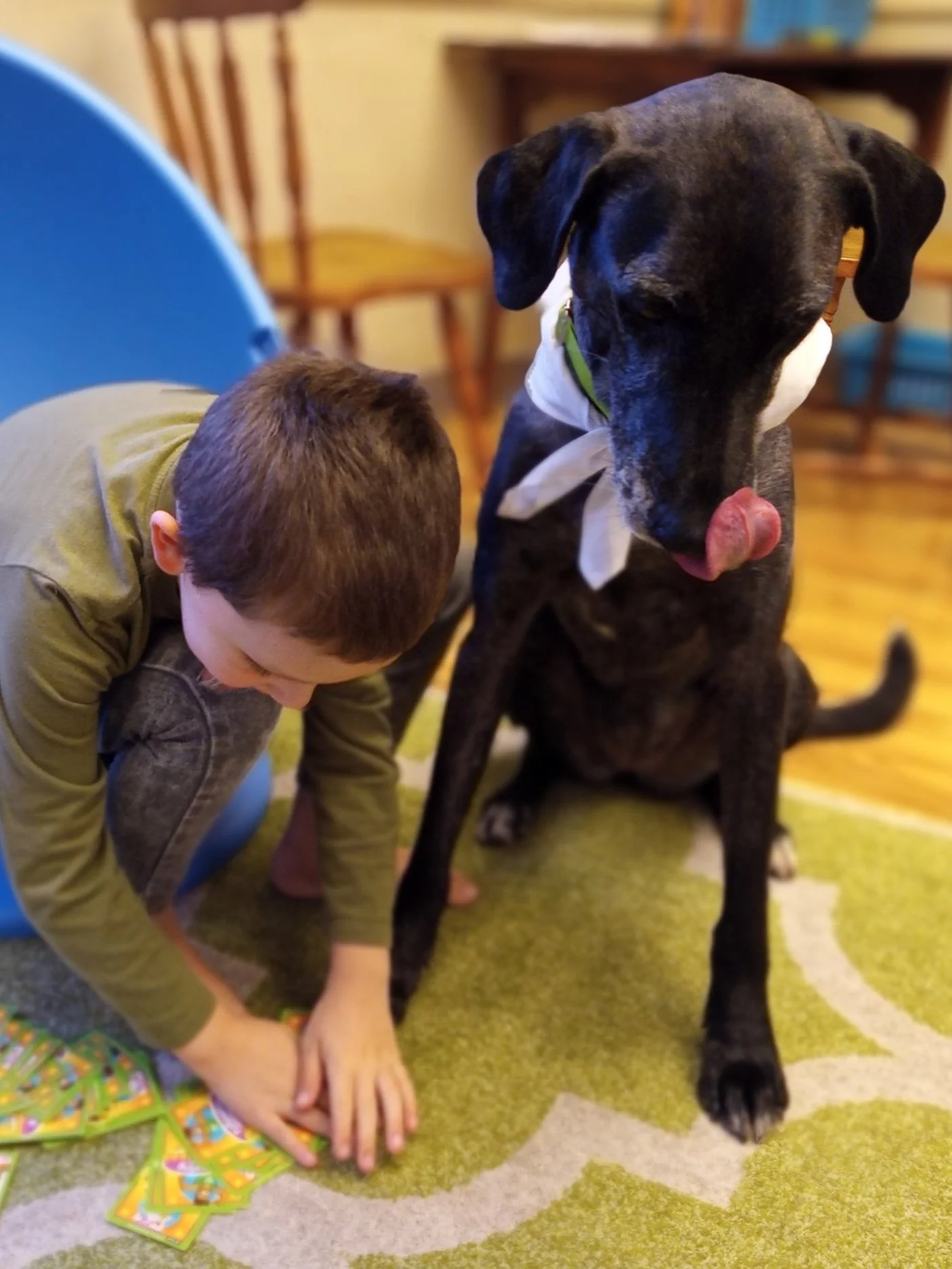
Speech therapy dog Delta expresses mild discomfort with a tongue flick when accidentally bumped. Watching both the children and the therapy dogs to intervene as needed requires constant vigilance, but it’s worth it!
If you click a link it is likely an affiliate link and I will earn a small commission if you purchase. It does not cost you anything extra. If I don’t use and love a product, you won’t find it here!
Therapy Dogs Mean Constant Attention…
…which yields many meaningful and memorable contexts for practicing communication skills!
Kids are impulsive, so I have to stay on my toes to watch out for any warnings that a child might:
· inadvertently become too rough,
· do something that might startle my therapy dog, or
· become dysregulated themself from the sensory aspects of a dog.
Likewise, dogs are dogs, with their own form of communicating discomfort with a situation, so I’m checking in constantly with my therapy dog’s body language during any interactive play to change or stop an interaction as needed. (Here’s a DVD and a book that I think are great resources about canine communication signals).
These moments are ripe for embedding a child’s goals, though. Among the many opportunities provided, my personal favorites are:
perspective-taking—teaching a child to tune into another sentient being for clues they are either enjoying or trying to avoid an interaction and responding in a way that keeps everyone comfortable.
I often partner with kids to co-create comic strip conversations or role-play with thought-bubble dry erase boards to analyze how one of my therapy dogs is feeling in a moment, then change one component of the interaction and try again.
With treats to reward their efforts my dogs are often willing to repeat activities more times than a child’s family members are in order to to figure out a situation. Plus, it’s less confrontational than pitting myself against the child.
It’s not easy to guide both a child and therapy dog through these interactions simultaneously, but I’ve found these type of activities stick more than just discussing the perspectives of book characters or people in hypothetical situations.
automating useful phrases—“excuse me” and/or holding out a hand for more personal space is my favorite functional phrase and gesture that many of my kids need to practice, whether it’s to mark each syllable for clarity or to advocate for their regulation needs.
Because my dogs love to be close to kids, they provide frequent opportunities to practice and it’s easy to set up situations to practice this playfully while still in the initial learning phases.
expressing questions—whether it’s checking for consent (Can I pet you?), practicing question inversion syntax (e.g., Do you want…?), applying new articulation skills (e.g., the /k-/ in “Can you…?”—click to see a video clip), or learning to combine words into short phrases (e.g,. “Where’s the toy/treat?”), a therapy dog’s reactions bring positive emotion and memorability to activities and can often be practiced in motion with more energetic kiddos.
recognizing and advocating for their own sensory needs—I’ve found that when a child is showing early signs of dysregulation I can incorporate a therapy dog as a neutral third party to avoid confrontation that might come from directing a child to ask me or their caregiver for help. Sometimes that’s:
asking for deep pressure input “squishes”,
slowing their breath in rhythm with slow pets down a therapy dog’s back, or
directing the dog to her bed to self-advocate for minimizing distractions,
Plus, by being so attentive I’ve found I’m often able to catch warning signs that a child needs help calming their sensory system earlier than I otherwise might if I wasn’t supervising interactions with my therapy dog.
(For more on this topic, see “Squishes, Deep Breaths, and Therapy Dogs—Oh My! How a speech therapy dog can improve sensory regulation.”)
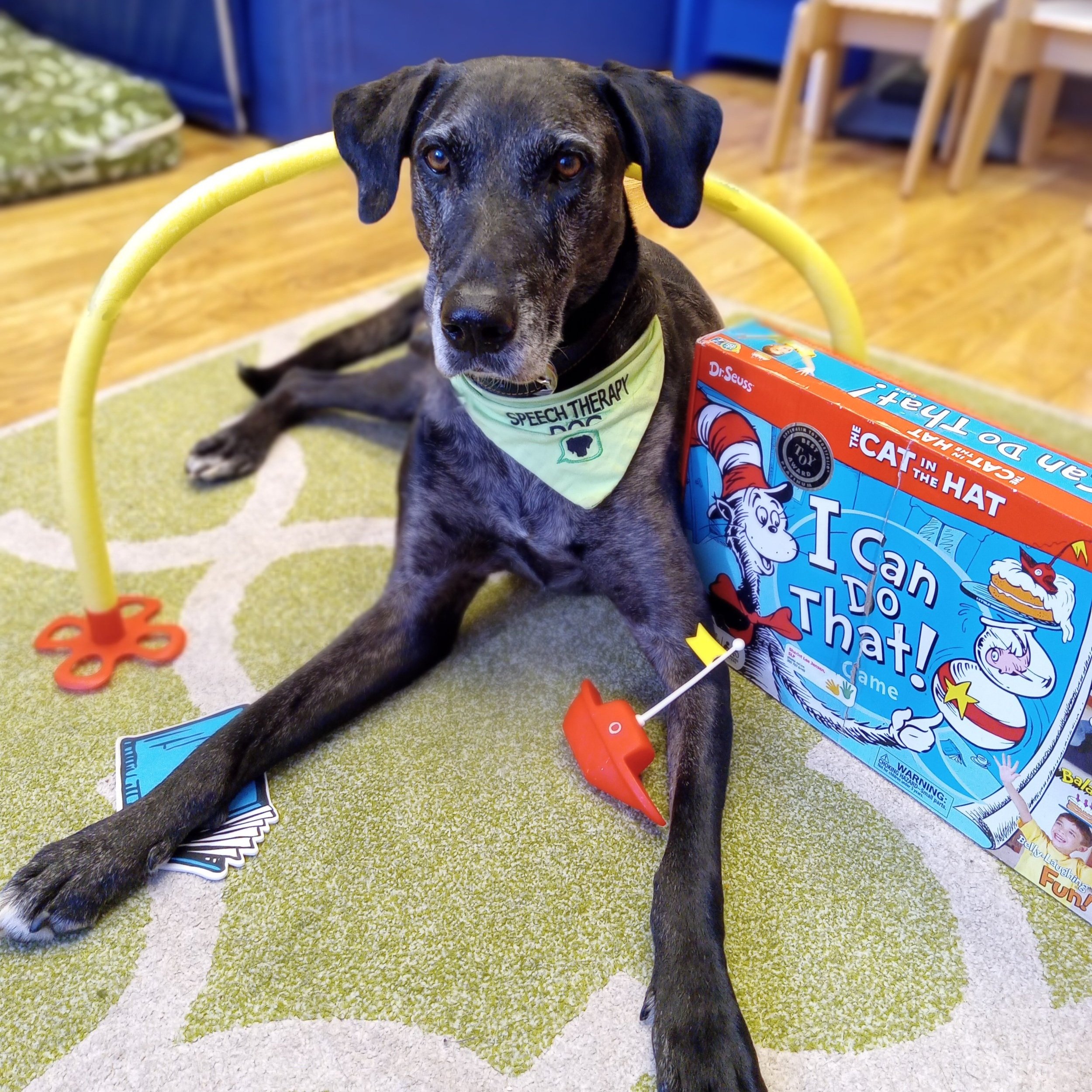
Therapy dog Delta poses with one of my favorite games for practicing question-asking. It can be easily adapted for animal-assisted speech therapy.
“Down time” between sessions looks different with a therapy dog
I’ve found that I actually treat myself more kindly at the office because my therapy dogs have needs to attend to.
I used to tax my brain non-stop during work days and was exhausted from decision fatigue by the end of the day. I scheduled clients nearly back-to-back so as one family was leaving the next was entering the waiting room while I rushed through completing data sheets or quickly returning missed calls.
I’d go home and crash on the couch, glazing over in front of a television show I’d never remember.
Since regularly partnering with my therapy dogs though, breaks between clients are actually breaks (well, for the most part).
I found I had to re-arrange my day to have at least 15 minutes between each family, during which I usually either go outside for a quick walk, toss a dog toy a few times to help them decompress, or clean the therapy room of dog hair which can be surprisingly meditative.
It may seem trivial, but being able to stop thinking about clients to focus on my therapy dog’s needs for even a few minutes at a time leaves me able to think clearer within actual sessions.
This also means I have to set aside actual paperwork time to complete all the clerical tasks that accompany the profession. Even though I sometimes rebel against sitting at a computer for a chunk of time, in reality I know that I’m better able to concentrate and ultimately get tasks completed more efficiently by seeing them through from start to finish in “deep work” mode.
With a dog sleeping or quietly chewing a favorite toy beside me, it’s really not that bad.
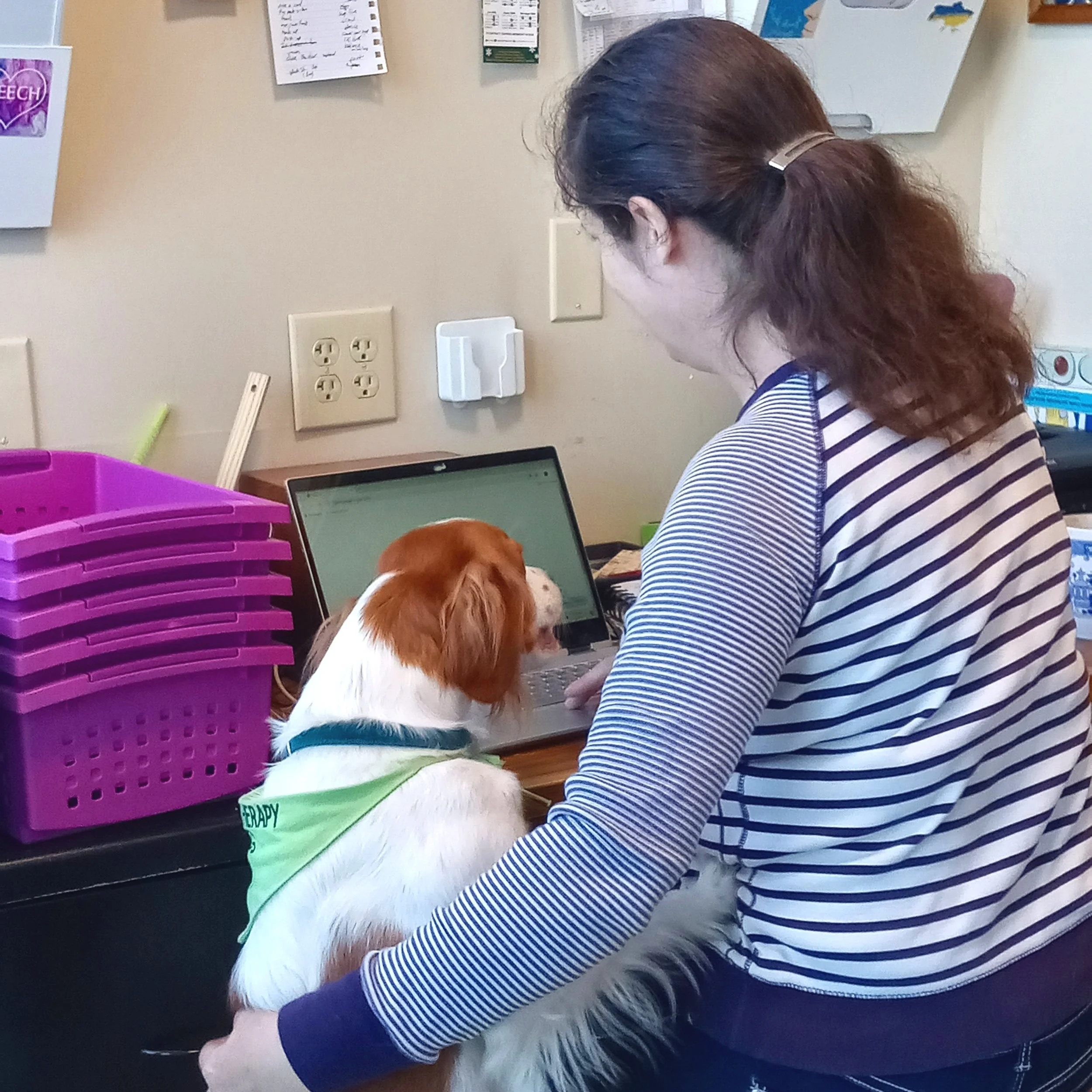
Therapy dog Sky provides support and a welcome distraction while I complete paperwork during a break between animal-assisted speech therapy sessions.
Unexpected therapy dog moments mean adapting plans creatively
My brain craves opportunities to think outside the box and I get easily bored completing the same activities over and over.
However, I see many of the same needs repeated across clients (e.g., are there any phonology kids who don’t need to work on /s/-clusters?) and can become stuck relying on the same few materials.
Bring a therapy dog into the situation though and you instantly introduce some unpredictability that can lead to new ideas.
Instead of or in addition to traditional therapy materials, children can ask the therapy dog to perform tricks that contain a target sound or phrase. Because the dog has a mind of their own, the trick may be performed incorrectly or in a silly manner, adding to everyone’s enjoyment while providing even more opportunities to say the target again.
Some games are even more fun when a child helps the dog take turns, increasing the meaningfulness and memorability of practice.
And of course there’s the unpredictable moments when a therapy dog intrudes on a situation or does something silly that can be quickly capitalized on to address a target (e.g., working on /s/-clusters? “Do I hear Delta snoring?”)
Is it difficult adding a speech therapy dog to your practice? Absolutely! But overcoming the challenges brings its own rewards—for both your clients and yourself!
To see more of how my speech therapy dogs help out at my private practice for pediatric speech, language, and reading, follow on Instagram @Speech_Dogs.
Want to pursue the path to animal-assisted speech therapy yourself? Check out the book Paws For Progress: Integrating Animal-Assisted Interventions Into Your Speech-Language Pathology Practice and the 7+ hour online course, Talk to the Paw: Foundations for Therapy Animal Inclusion in a Professional Setting.
May your days be filled with puppy wiggles and children’s giggles,
Sharlet