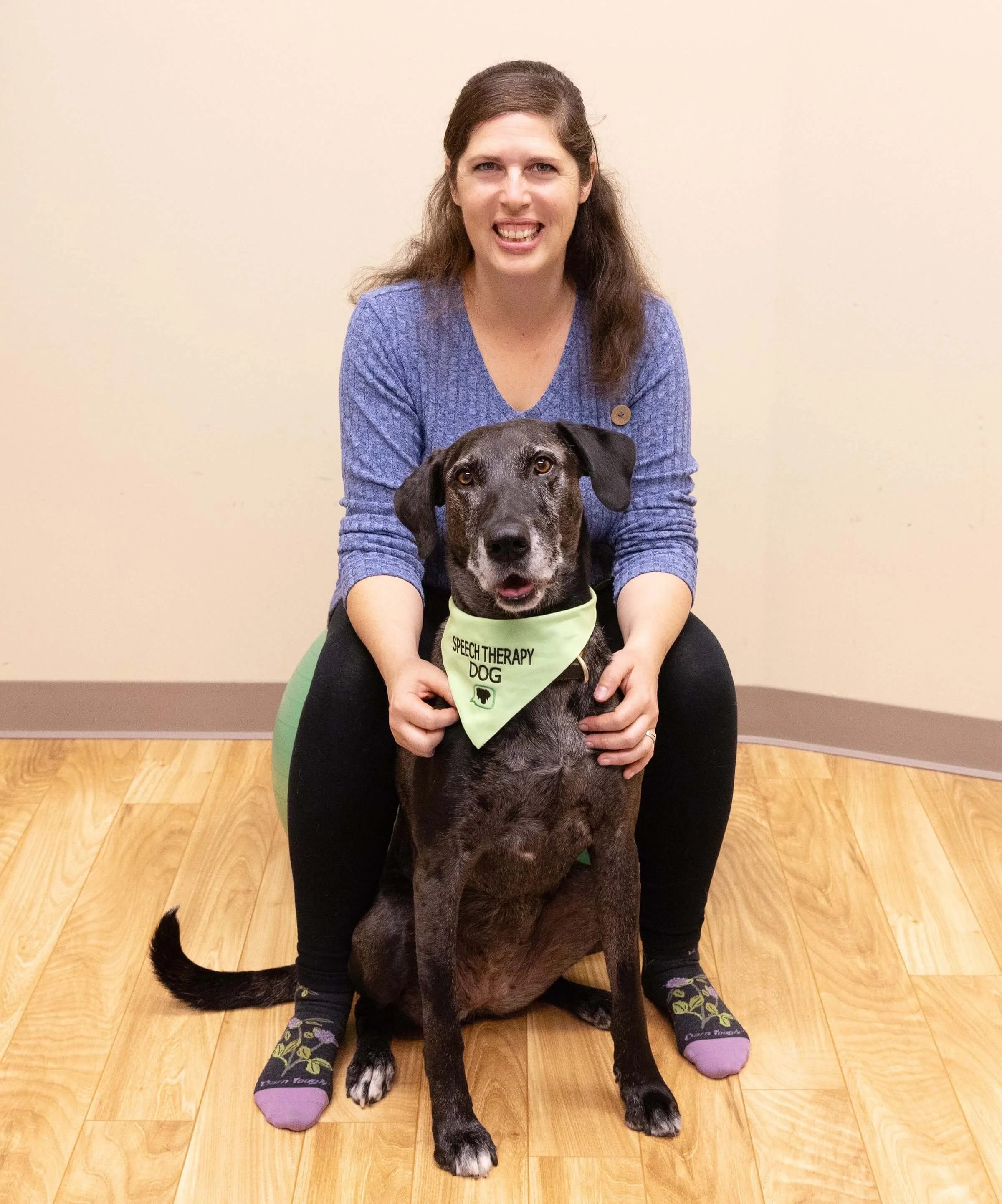
Three “Firsts” in My Journey with Animal-Assisted Speech Therapy
“Oh my, maybe this wasn’t such a good idea!”
That was thought running through my head as I watched Sky bombing around the office that morning, tongue lolling out of her mouth, little sassy barks emanating from her mouth with each play bow at my feet.
It was supposed to be her first full day at the office, with six kids on the schedule. Why did I ever think she was ready for this?!?
This is also the thought that has gone through my head at several other times over the past few years as I’ve increasingly used therapy dogs to address the goals of my pediatric speech, language, and literacy clients.
Imposter Syndrome?
Anxiety?
Truly just a bad idea?
Or…perhaps animal-assisted interventions are an area that takes time, patience, and perseverance to become successful at.
“First” #1—Delta’s first speech therapy dog visit to the office
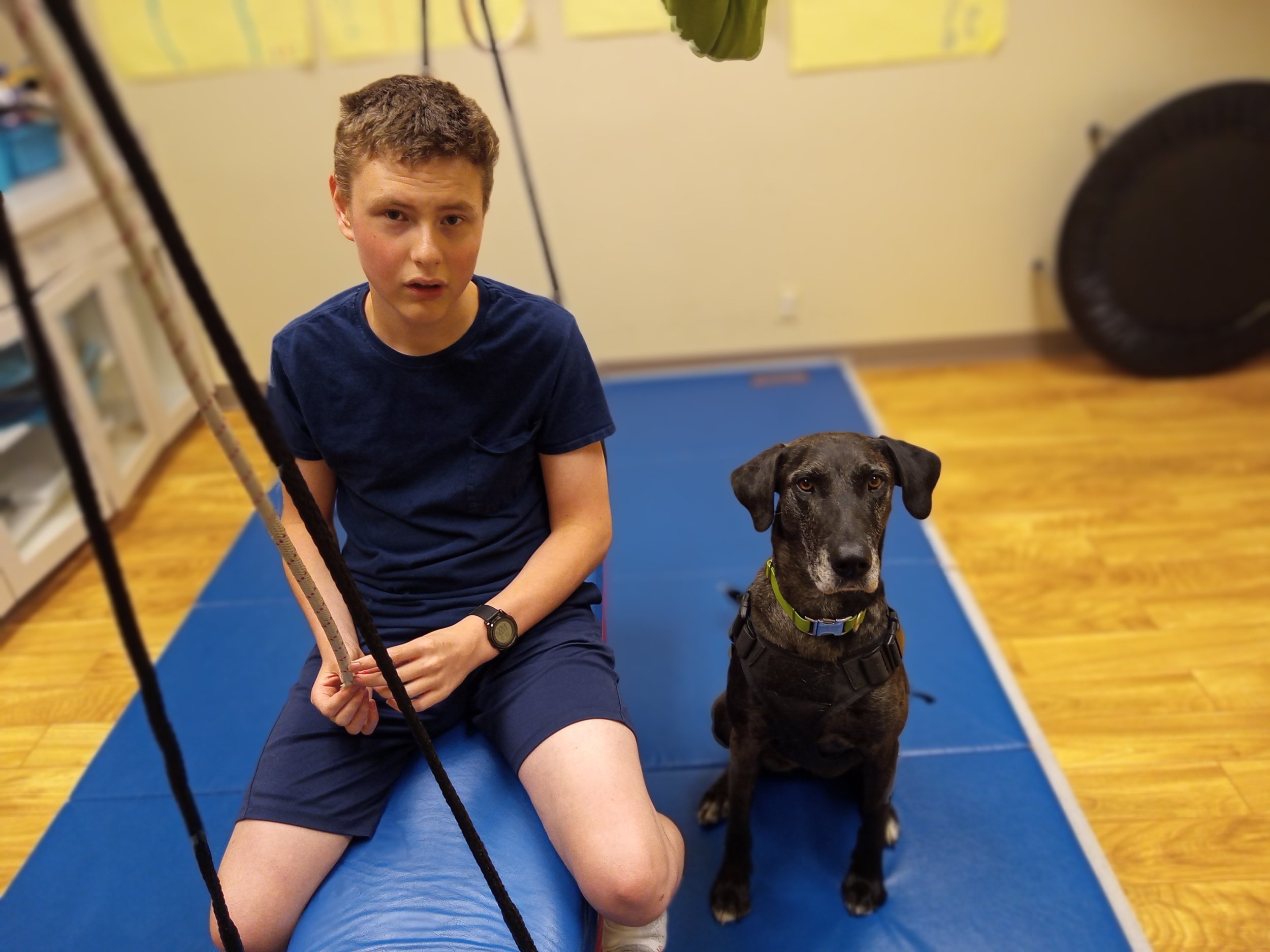
Therapy dog Delta provides support to a child during animal-assisted speech therapy.
If you click a link, it’s likely an affiliate link and I will earn a small commission if you purchase. It doesn’t cost you anything extra. If I don’t use a product and love it, you won’t find it here!
So the first time I brought Delta along to work, I was not thinking of a long term speech therapy dog career for her.
I had one child who I desperately needed to connect with and I was out of other ideas. (For that story, see My Journey to Animal-Assisted Interventions here). It was about nine months post-adoption, with lots of ups and downs socializing in public due to her noise phobias and fear of men. She had come with me to the office on numerous occasions to complete paperwork, so the environment was familiar and comfortable.
But driving in that day, for a special session I’d arranged for just this one child, all the “what ifs” started to flood my brain.
What if he doesn’t like her?
What if he’s having a bad day and gets out of control, will that scare her?
What if she bites him?
Fortunately my fears quickly proved unfounded. These two bonded instantly and maintained that bond for nearly five years before the child “graduated” from speech and literacy therapy. Though I now have much more information about training speech therapy dogs and reading their body language (see the animal-assisted speech therapy materials page ), I’m glad I went for it that day.
If I’d been too scared to try I would have never found this amazing path that has helped improve both my clients’ outcomes and my job satisfaction.
First #2—Sky’s first full day as a speech therapy dog
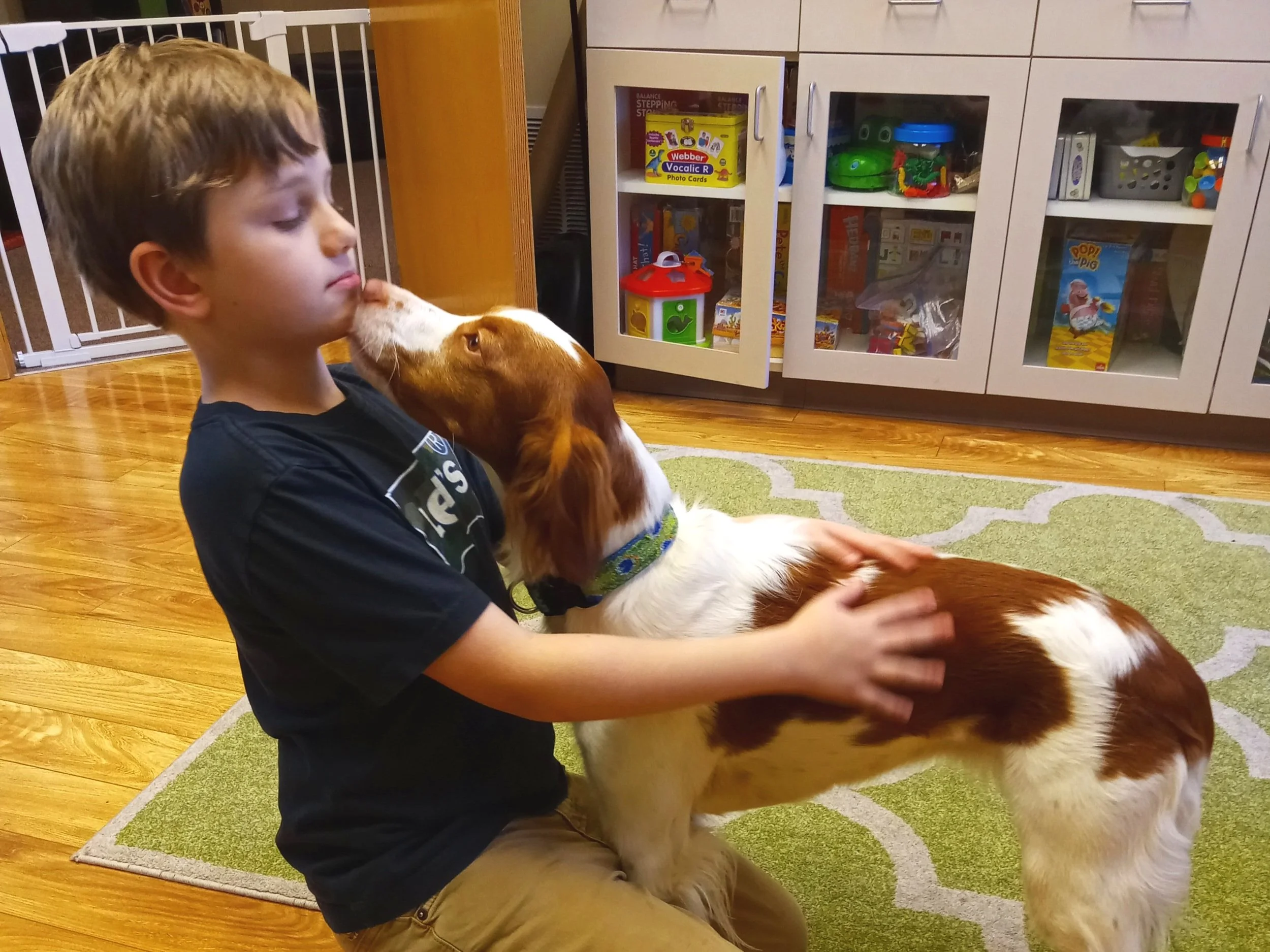
Therapy dog Sky gives a child a friendly kiss on her first day providing animal-assisted speech therapy.
Having learning a lot from my experiences with speech therapy dogs Delta, Johnny Utah, and Bodhi, I’ve felt much more confident and prepared for every stage of training Sky so far.
Sky is my mom’s dog, but they live on the property with us and I see her daily. From puppyhood she has had a strong drive to interact with humans, called an affiliative nature, and I’ve been wanting to give her a job. But…she’s super high energy.
Now, I found with Johnny and Bodhi that a higher energy speech therapy dog can be really helpful for engaging more passive kids and stimulating spontaneous language (and laughter!).
And Sky has exceeded my expectations in obedience classes, becoming directable through distractions and reliable in basic commands.
She’s been to the office many times, initially alone and gradually with one or two dog-wise families coming in for socialization and training opportunities.
I had a holiday where a couple kids had cancelled in advance so I knew it wouldn’t be an overly long day, and the families that were coming had all agreed they’d love to meet her. My mom was available to come pick her up if things weren’t going well. I’d checked off all the boxes in my head, but still I worried.
Cut to the morning of…
Fortunately, I’d planned to arrive early to give her a chance to settle. We had a plan—plenty of play, a calming massage, and some focus work before the first family arrived (to see a video, click here). And…
Sky exceeded my expectations!
Yes, she was pushy for attention and no she didn’t keep “four on the floor” to greet people as I wanted, but laughter and smiles abounded. She actually laid down on her own to rest on several occasions, even falling completely asleep during our lunch break, and she consistently demonstrated “active consent”, going back again and again to interact with both kids and adults.
Is there still a lot to work on before she’s a full-fledged speech therapy dog?
Absolutely! She will need better boundaries (we don’t need quite so many kisses), more impulse control (“four on the floor” anyone?), and maybe a less adrenaline filled start to the day. There will be more obedience work and evaluations over the coming months, but I look forward to gradually transitioning her into work days when the situation is right.
(Update: Sky has just completed her second full year of work and is doing amazing! Still impulsive and clownish, but that’s to the delight of many kids.)
“First” #3 The first time my ideas about speech therapy dogs weren’t rejected
I’d researched.
I’d experimented.
I’d journalled various thoughts and epiphanies for two years.
Finally, I decided since no-one else had done it I needed to write a book for other Speech-Language Pathologists about the possible benefits of partnering with a therapy dog for animal-assisted interventions.
So one winter break I did. At first I would type for an hour or two, mostly anecdotes from various session that stuck in my brain.
Then I started classifying interactions:
were the therapy dogs actively involved for this or was their passive presence enough for the situation;
was this something that was based on research or my own intuitive creation;
was I incorporating a therapy dog for initial learning or generalization opportunities?
And within a few days I was lost in thought for hours at a time, my experiences pouring onto the page. But would anyone else be interested?
I sent my manuscript to eight publishers. I heard back from six, four of which said the topic was “too niche” and/or “not evidence-based enough”. My favorite was one company that had clearly not even read my cover letter, much less looked at the main text: “We regret to inform you we do not sell animals on our site.”
But just as I was debating between self-publishing or throwing it in the trash, ASHA Press emailed with extensive notes. I read through the email, interpreted it as a rejection, and went about my life.
Fortunately, they checked back to see if I was interested and I realized they actually had seen potential in my initial draft and wanted to work with me to make it better.
And they did!
It’s been a long couple of years, with lots of edits, sections added and deleted, countless discussions over precise wording and organization, but I couldn’t be prouder of the end result.
Animal-assisted interventions are a growing field, and there’s only a handful of SLPs involved at the moment. I’m sure there will be more information to add to the topic in the years to come and I’m sure I’ll refine my clinical animal-assisted speech therapy skills further as well.
For now though, I’m pleased to announce that Paws for Progress: Integrating Animal-Assisted Interventions Into Your Speech-Language Pathology Practice is available to help you start your therapy dog journey today!
In the meantime, if you’re interested in learning more, follow on Instagram @Speech_Dogs and look around speechdogs.com to find video examples from actual therapy sessions, helpful resources and products, and additional informative blog posts.
As I continue working with my speech therapy dogs Delta and Sky and latest partner young Zephyr, I try to appreciate how far each has come and how much farther each of us can go individually and as a team. And I try to channel of little of Sky’s enthusiasm and playful nature each day!
May your day be filled with puppy wiggles and children’s giggles,
Sharlet