Different Dogs, Same Job: Flexibility as a Skill in Animal-Assisted Speech Therapy
Pop quiz! Flexibility is:
a) being able to stretch the muscles of your body
b) being able to shift plans when a situation changes
c) a vital therapy dog handling skill
d) all of the above!
While it’s hard to believe, I’ve now partnered with five different speech therapy dogs. Each has had their own unique blend of strengths and weaknesses, individual personalities, and personal quirks. And as the human side of the pair, it’s been on me to show flexibility in adjusting my approach to working with each one!
Here’s just a few examples that impact me as I juggle the demands of animal-assisted speech therapy…
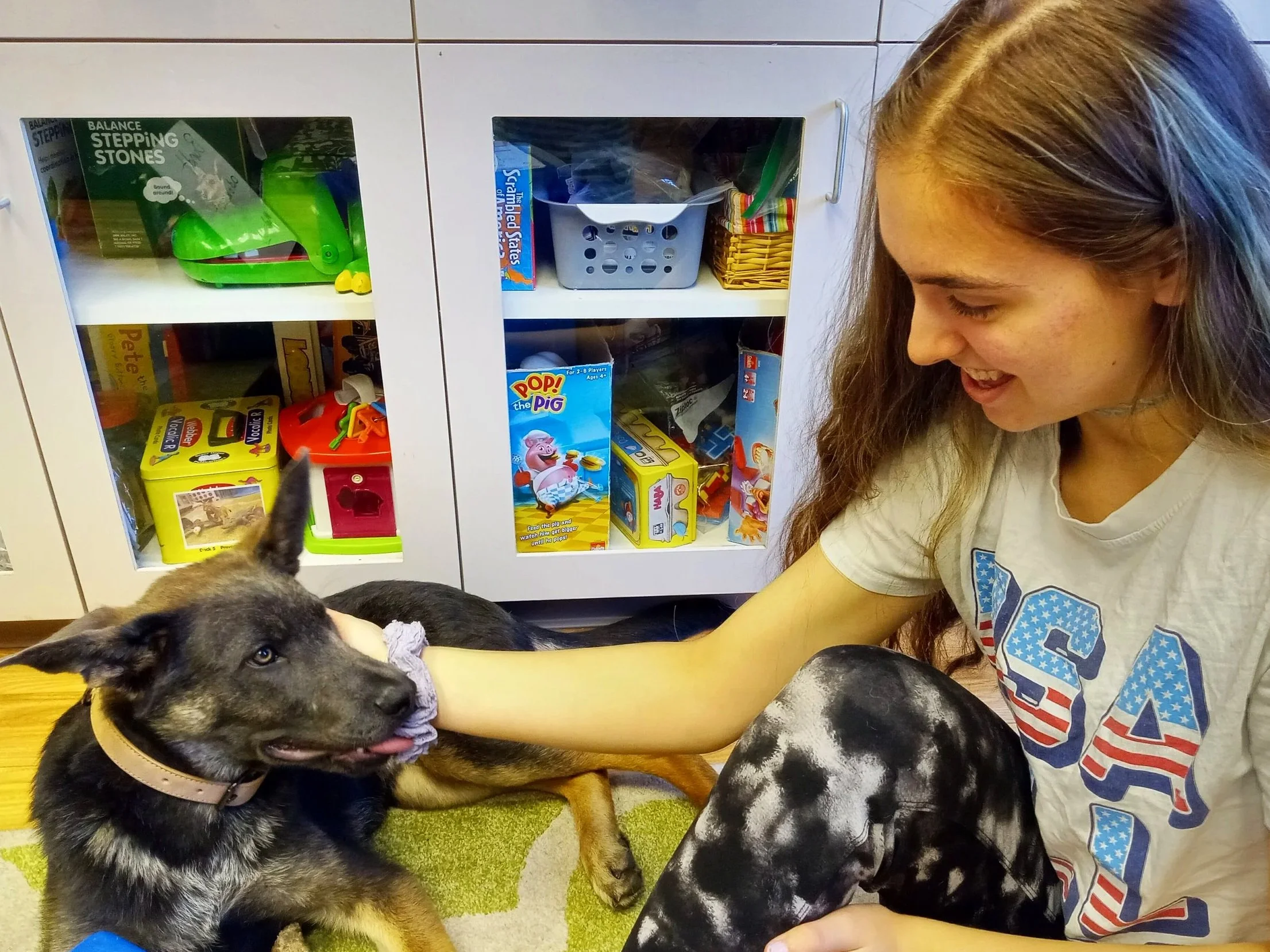
New speech therapy dog Zephyr has a super high drive to interact with people, providing both joy and unexpected challenges in our work.
Haters gonna hate.. but Zephyr’s gonna Zeph
While Delta loves people she knows and Sky loves all people but is easily distracted by the possibility of birds to chase, Zeph is quite simply people-driven. He’s my most socially driven dog. So while I’ve learned to let Delta and Sky choose who to interact with outside the therapy room (e.g., heading through the lobby and parking lot) and to respect their agency to not engage with strangers as they see fit, I’ve had to pivot my approach with Zephyr.
Though I have worked with Zephyr to disengage if someone is showing body language they do not want my dog to approach, I have found he actually gets more stressed if not allowed to say hi than if I just give him a moment to interact before moving on. So while I generally walk Sky and Delta with purpose and avoid eye contact as we head out for bathroom breaks, with Zephyr I’ve pivoted to making eye contact and asking if passersby want a puppy greeting.
Both approaches reduce stress but for different therapy dog partners. And less stress outside the therapy room means more enjoyment of work days.
(Of course, Zeph is still quite young. It’s entirely possible with maturation and/or harder work expected within therapy sessions that he may feel less inclined to socialize outside the office. If that’s so, I’ll be ready to follow his lead.)
Quick as a Cricket, Slow as a Snail
Sometimes my speech therapy clients will speak with a very rapid rate that makes them harder to understand. I have a visual chart that we refer to together, showing a cheetah at one end of the continuum and a snail at the other. I usually ask the kids to provide an example of a medium or “just right” speed animal to emulate, and many pick dogs because they like them and so many of my therapy materials already feature dogs.
In reality though, my three current therapy dog partners could represent the whole spectrum. Sky is definitely the fast one, darting here and there and never wanting to miss a thing! It’s full-on FOMO, all the time. Delta, while she can be fast if need be, tends to be pretty steady in her movements—responsive but not frantic.
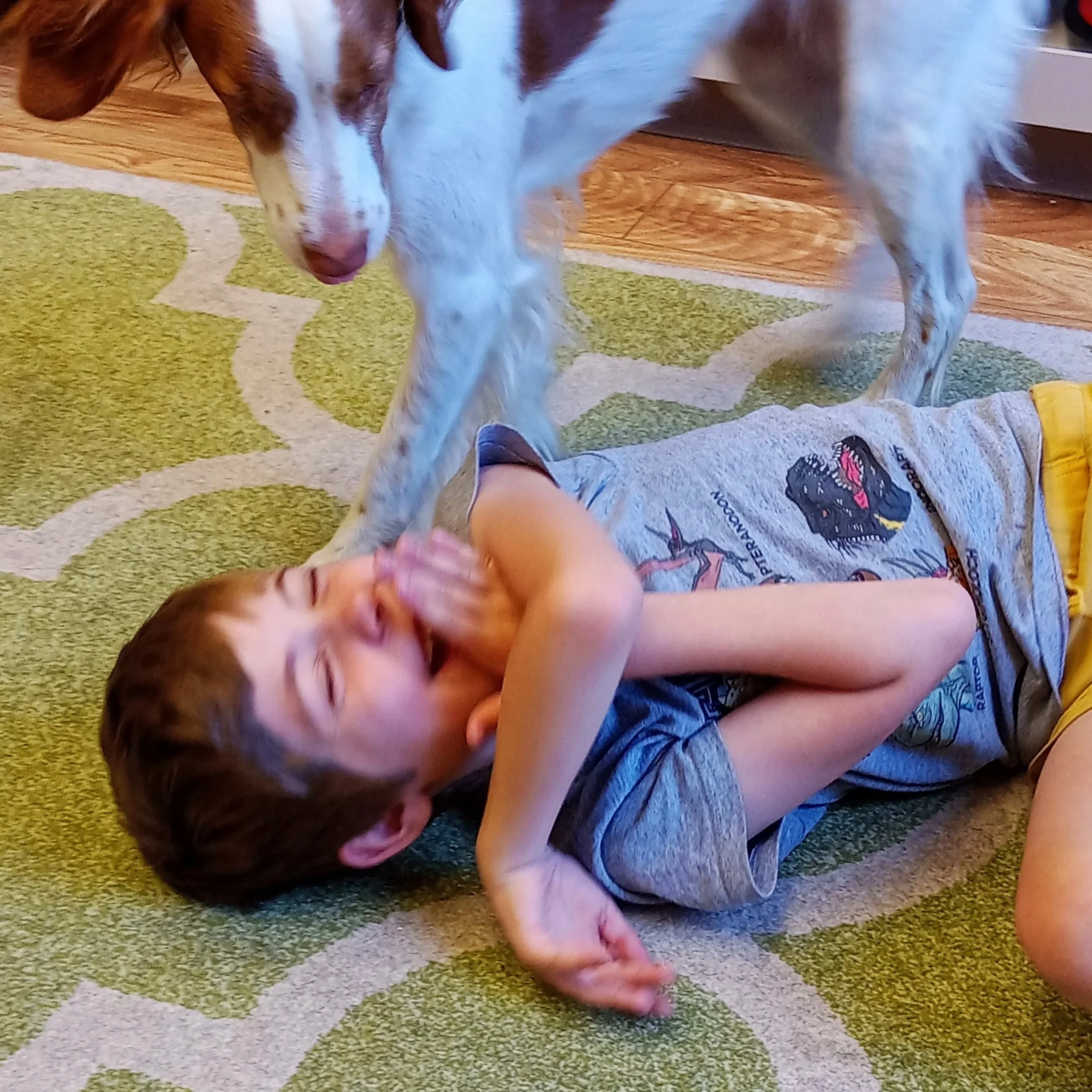
Little Sky is quick as a cricket in everything she does and loves high-energy play during animal-assisted speech therapy session!
Zephyr—he moves at his own pace. Even as a young pup he was always chill; in fact, it’s one of the main reasons I selected him for speech therapy dog work. He’s very obedient and eager to please, but his “drive” is pretty low. Out on hikes he’s happy to do a little trot to explore. Ask him to spin and he’ll happily walk in a circle. Want to play tug or fetch? He’ll oblige, but just don’t pull too hard or throw the item to far or else he might just sit and look at you.
Even though I work to incrementally build his drive to play and perform tricks, I’ve also adjusted my expectations of his response time. I’m not competing in an obedience ring with him, I just need him to follow some cues within reason. Aside from that it’s his affiliative nature where he really shines!
Shifting my work hours to accommodate my therapy dogs’ needs
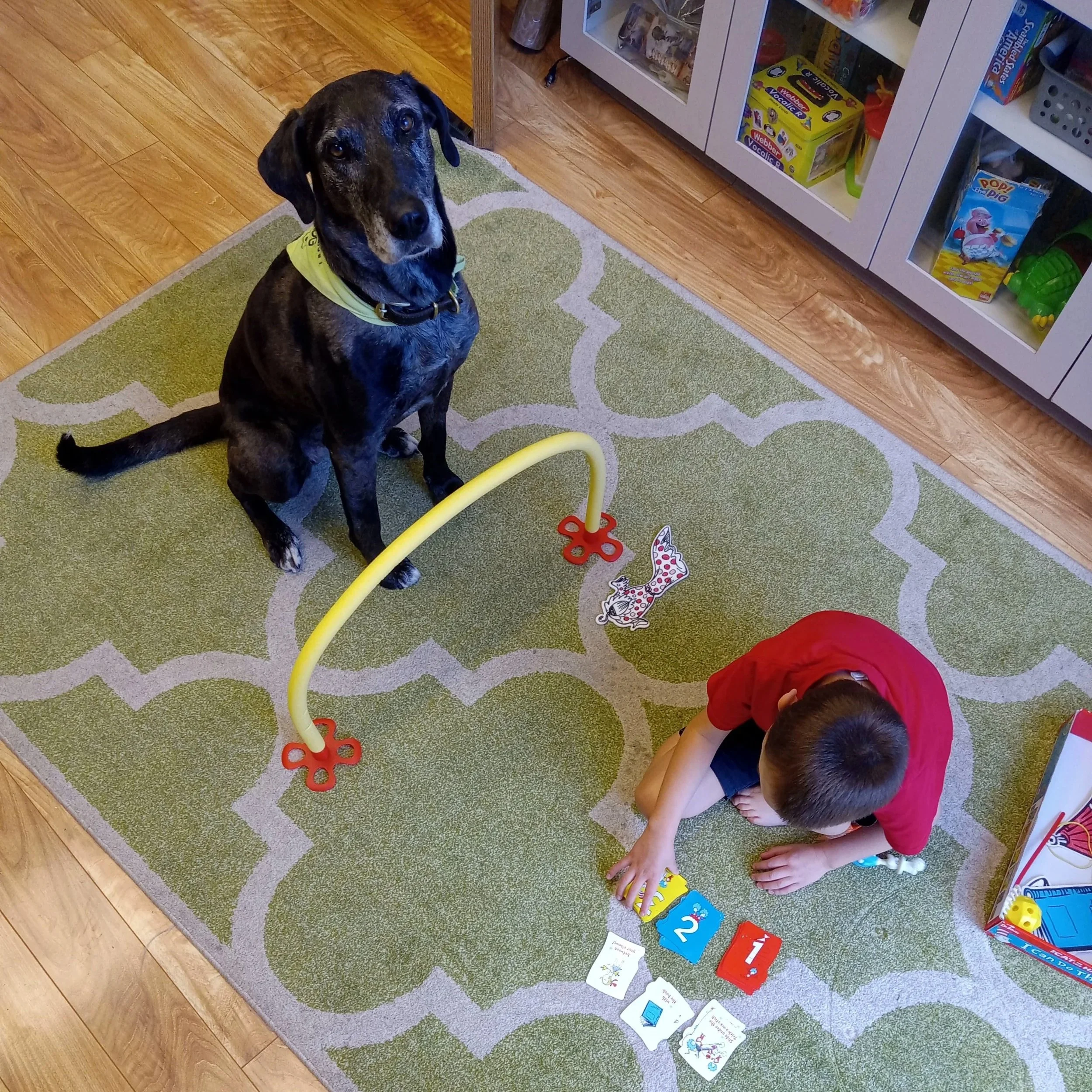
Veteran speech therapy dog Delta, who helped me learn the importance of reasonable work day lengths and down-time to rest and decompress.
If you’ve heard me guest on a podcast, you’ve probably heard me mention that I started out doing everything wrong.
Overworking Delta was a major theme in those first months, when I not only thought she should be actively involved for part of every single session (see Top 3 Mistakes I Made When Starting Animal-Assisted Interventions with a Speech Therapy Dog), but also had scheduled very long work days to accommodate both before and after school availability.
While I had worked two, 12 -13 hour days per week for years when on my own and loved the flexibility it gave me to focus on equestrian sports the other five days of the week, that grind was simply too much for my therapy dog partner. Despite her very accommodating nature, Delta would be grouchy by the end of the day. In fact the two incidents we had of her acting somewhat aggressively towards kids were both 7pm clients who startled her awake (again, I wasn’t very good yet at recognizing and advocating for her boundaries and there weren’t the “how-to” resources available to learn from that there are today).
While I was already working to reduce my overall caseload a bit to provide some down times throughout the day, three months in my animal-assisted therapy journey Covid hit. Between the increased need for time between clients to disinfect and a sudden drop in families able and willing to attend in person, my work hours naturally shifted to an admittedly more reasonable three, 8-9 hour day. I also reduced my session length by five minutes, giving me just a bit more time to get outside for biobreaks without sacrificing time to complete data sheets and stay organized.
(Note: Many volunteer therapy animal organizations limit a work day to two hours for therapy dogs. This sometimes creates confusion for professionals wanting to incorporate a therapy animal and trying to figure out the logistics of this. However, these are two very different situations.
Volunteer teams are going to novel places and actively engaging for the duration of the visit, which can be very cognitively and physically tiring.
In a professional setting, the therapy dog is in a familiar environment and likely having lots of time acting in a more passive, supportive role that takes less energy. However, monitoring your therapy dog partner’s energy level and when in doubt providing more down time is highly important for their welfare and client safety.
For more, see Therapy Dog Explained: Active Presence, Passive Presence, and Animal-Related Engagement on the Speech Dogs YouTube channel.)
Flexibility as an ongoing need in animal-assisted speech therapy
As someone who can tend towards rigid thinking patterns myself and also works with neurodivergent clientele who can do so as well, staying flexible and considering changes to my approach to animal-assisted therapy is an ongoing challenge.
Sky has a lot of food allergies, so I’ve gradually changed out the treats I have at the office so I don’t need to worry so much if kids pick from the “wrong” treat bin.
Each of my dogs has a particular—and different—location they are willing to use for biobreaks. So if I’m in a hurry, I better remember which door to head out of when they need to go so as to not waste time trying to cajole them to go in the “wrong” spot.
Two of my dogs are happy to go on “adventures” up the stairwell and/or elevator if it motivates a child to work harder; one is terrified of these places, so I have to find alternate ways to meet a child’s need for a walk (and usually work on flexible thinking with the child as well).
Yes, it’s a lot of work.
But, I suppose if this work was easy, everyone would do it and it wouldn’t be so special.
If you’d like to learn more about partnering with a therapy dog, check out the FREE one-hour intro video “Welcome to Animal-Assisted Interventions: The What and Why Behind AAI,” the book Paws for Progress: Integrating Animal-Assisted Interventions Into Your Speech-Language Pathology Practice, and the 7+ hour online course Talk to the Paw: Foundations for Therapy Animal Inclusion in a Professional Setting.
May your day be filled with puppy wiggles and children’s giggles,
Sharlet
Related articles: