Have You “Prehabbed” Objections? Preparing for a Future of Animal-Assisted Speech Therapy
Lately I’ve seen this word “prehab” (as in pre-habilitation) popping up in social media posts talking about preventing objections to a potential new service provision model.
It got me thinking…
What can we do to proactively to set the stage for introducing animal-assisted therapy into our work? How can we help others to see that the benefits of the human-animal bond can far outweigh the risks of adding a speech therapy dog into our practice if done correctly?
I admit, since I run my own private practice the only person I had to convince when I started bringing therapy dogs to work nearly six years ago was myself.
But really, I first started toying with the idea early in my career when I was still working for a non-profit center.
My first little spaniel, Harvey, would have been a terrific speech therapy dog, but my boss was worried about taking the risk and I didn’t have the knowledge base to effectively express how we could make it work. So instead I made social stories and language books with photos of him that were a huge hit with my preschoolers, an idea that would now be called animal-related engagement.
Fast forward twenty years and I now have a pretty solid understanding of both risk mitigation and how to incorporate animals to improve client outcomes.
So what are some steps you can take well in advance to help your colleagues and employers see the potential for expanding into animal-assisted interventions? Here’s a few ideas:
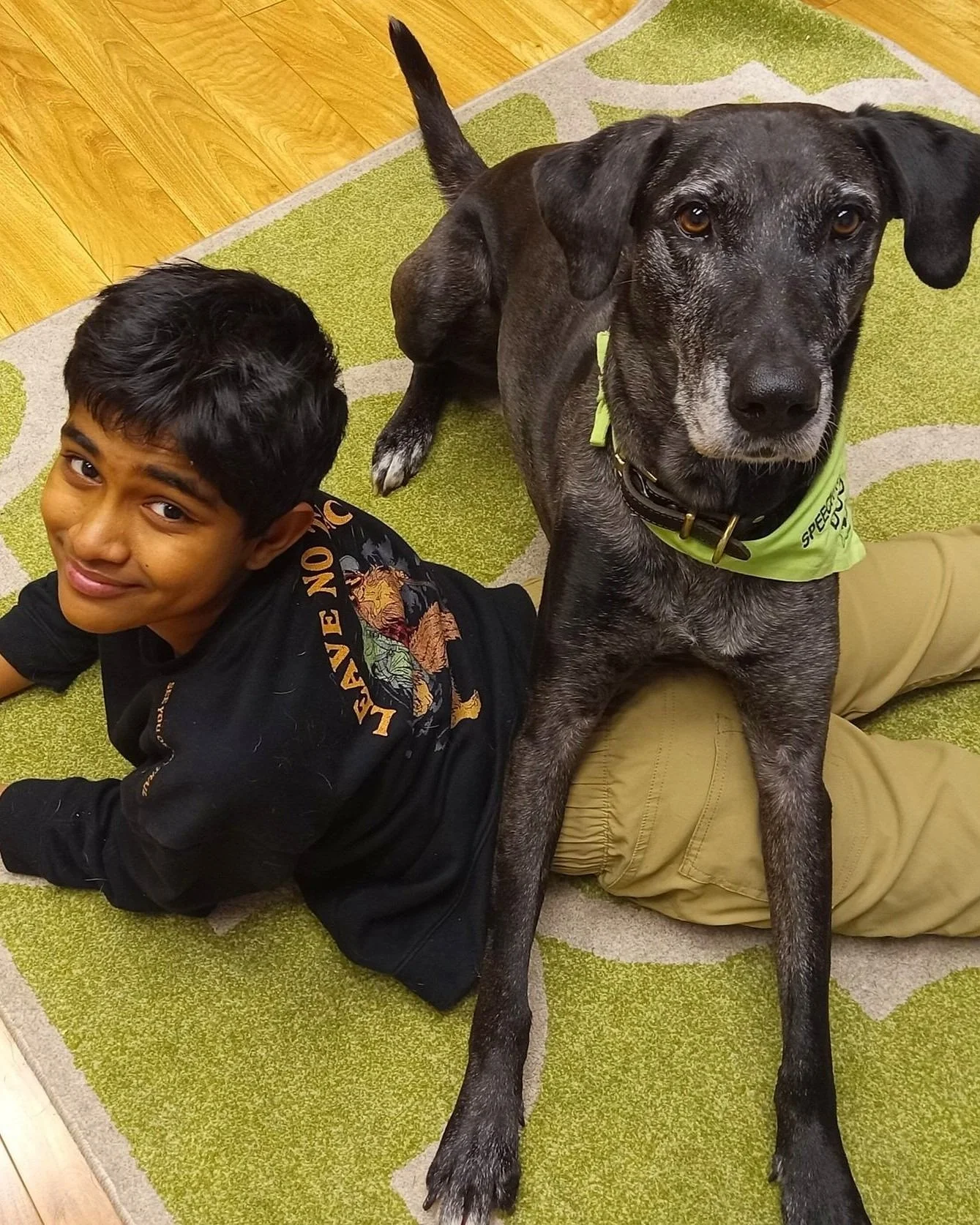
How did I get from being told “no” by a former boss to including animal-assisted speech therapy activities every day? Lots of preparation! Here, speech therapy dog Delta provides calming deep pressure input.
If you click a link it may be an affiliate link and I will earn a small commission. It doesn’t cost you anything extra. If I don’t use and love a product, you won’t find it here!
#1: Make sure you are already effective with the traditional approaches of your field before adding a speech therapy dog.
Animal-assisted interventions add a lot to your cognitive load as a therapist, including:
· maintaining vigilance over interactions,
· splitting your attention between client and therapy animal, and
· being flexible in how a session runs depending on the client-animal interactions that are occurring (or not) that day.
If you’re still spending maximum brain power on creating basic activities and monitoring your client’s success in order to respond accordingly, adding a therapy animal could be too much to add right now.
Not that we’re ever perfect!
In fact, the longer I work the more I realize how much I don’t know.
But those first years of work it’s totally normal to feel drained at the end of a work day from all the decisions you’re making in sessions. This gets easier with experience. And it’s going to be individual to each person. So just make sure you honestly assess whether adding another HUGE level of responsibility is something you’re up for at this point in your career.
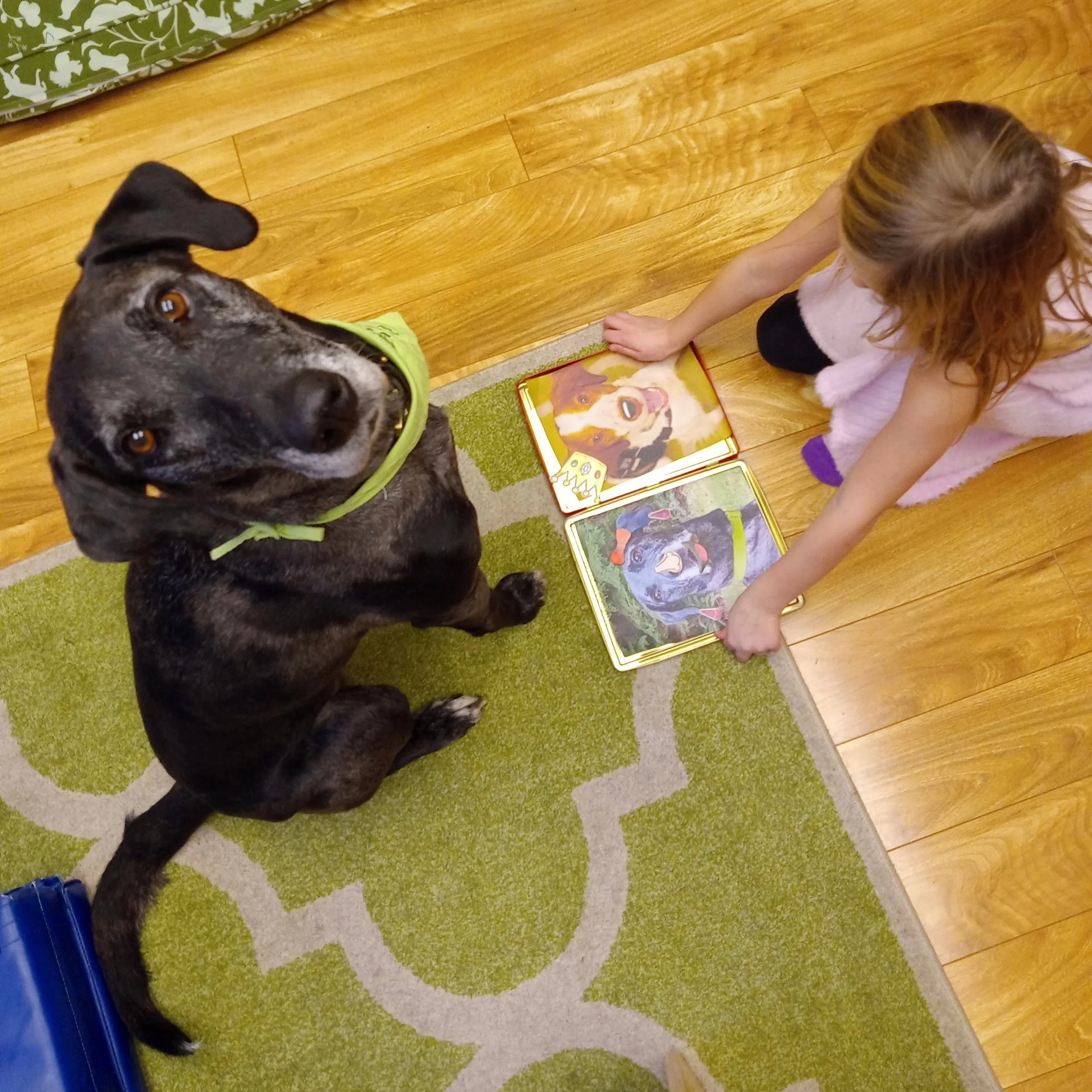
Delta looks on as a client shows off magnet faces she created while practicing saying “she needs…” for both “sh” articulation and pronoun practice. I already had this activity in my repertoire and just altered it slightly to add an animal-assisted therapy component when I started bringing my speech therapy dogs.
In the meantime…
#2: Educate yourself on how to best bond and communicate with your chosen therapy animal species.
Even if it’s not education specific to animal-assisted therapy, the more you can learn about animal psychology and training the better foundation you will have to build on.
If you’re interested in working alongside a therapy dog, learning all you can about dog psychology and dog body language will give you a great step up when the time is right to start your partnership. I wish I had been better at reading my Labradane Delta’s signals (she can be quite subtle compared to my spaniel partners) before I started bringing her. It would have prevented a couple startling incidents in the beginning when I didn’t adequately respect and reinforce her cues for space and rest.
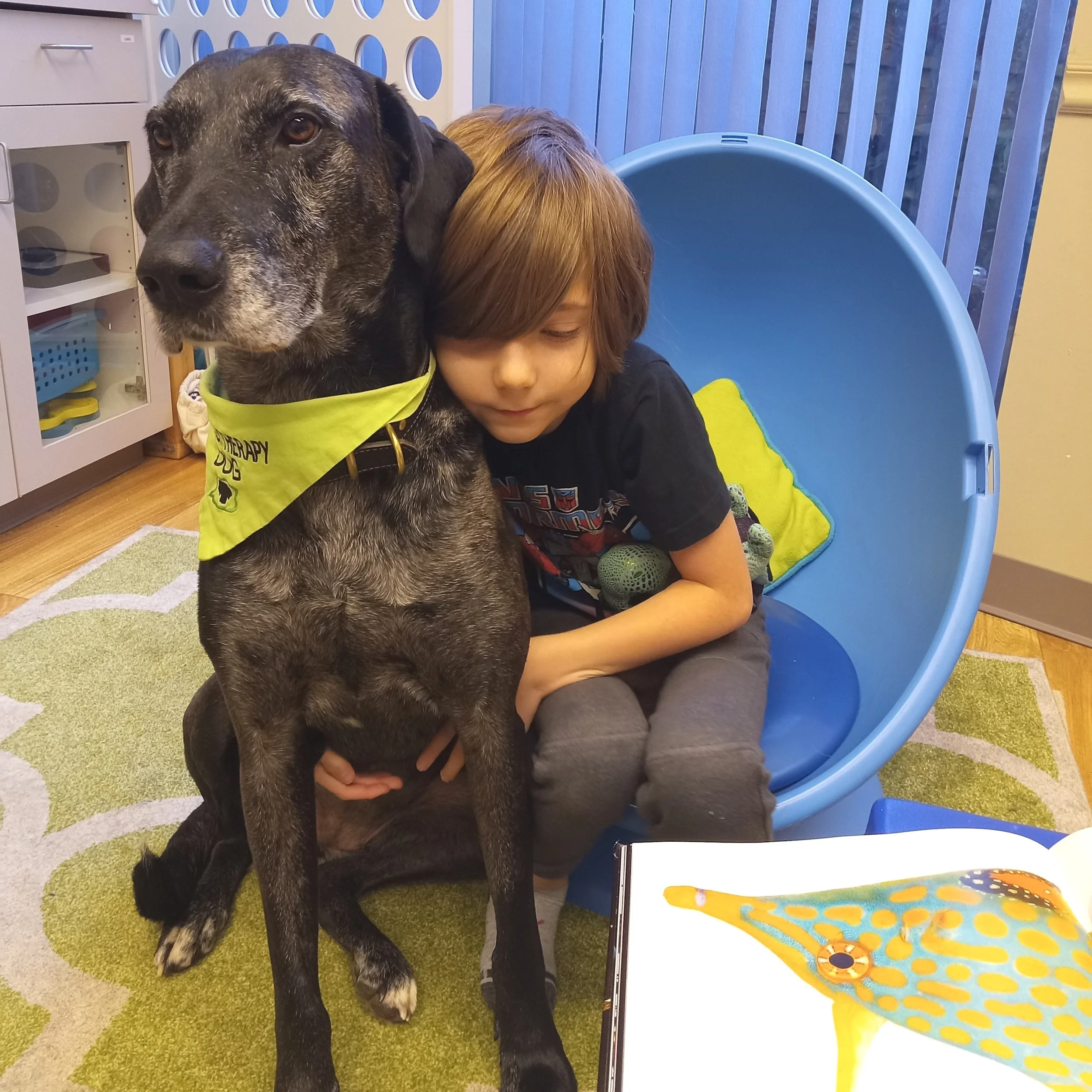
Watching therapy dog Delta’s subtle communication was a big learning curve compared to my more “outspoken” spaniels. While I don’t generally allow hugs, here I can tell from her relaxed ears and posture that she is comfortable with this boy’s gentle and well-intentioned embrace as he works to calm his body.
For my favorite resources, see the Animal-Assisted Therapy Books and DVDs page. You can also download a free Therapy Dog Behavior Bingo Board to help train your eye while watching our canine friends interacting at dog parks, vets, and other settings where they might react to a bit of stress.
And if you have a therapy dog partner in mind for the future as you’re honing your own professional skills, you can always start taking classes together to:
· cement your bond,
· improve your ability to read his or her unique signals,
· establish the manners foundation needed to pass third party evaluations for work suitability, and
· maybe even learn a few fun tricks that will someday help engage your clients.
Bored with traditional obedience classes? Rally obedience, agility, barn hunts—all will improve your ability to read your dog’s signals, teach you how to teach them, and build that important bond so they will look to you for guidance when a stressful moment arises.
#3: Start looking at your work environment from a speech therapy dog’s perspective.

Speech therapy dog Sky takes a much needed rest on the bed in my inner office, which functions as a “retreat space” when needed.
Is there adequate room for your furry partner to have a retreat space when they need a break or need to be separated for their own welfare?
Are there therapy materials that might be startling and require some desensitization or switching to an alternative item?
Does the flooring have enough traction for a therapy dog to safely and confidently move about?
(While I don’t have a slick floor at work, these toe-grips were a game-changer when my old dog Gia developed arthritis and dementia and struggled to keep her footing on my linoleum kitchen floor. Once they were on she didn’t seem to even notice them and they lasted weeks at a time, giving her the confidence to join us in the kitchen again for the last year of her life.)
Now is the time to problem-solve how you’ll handle these situations so that when the time is right to introduce your animal to work it’s a positive experience for all involved!
#4: What continuing education can you take to show others you’re approaching animal-assisted speech therapy with diligence and foresight? How can you share this information in a concise but impactful way to get buy in?
One possibility is earning a Certified Animal-Assisted Intervention Specialist credential from the Association of Animal-Assisted Intervention Professionals. You can apply regardless of whether or not you are currently partnering with an animal.
I’ve taken the test myself and it’s a robust compilation of topics with heavy emphasis on risk management (liability, disease transmission, animal welfare, informed consent) as well as the evidence base behind AAI as an effective treatment modality.
While it doesn’t delve into profession-specific “how-to” tutorials, it’s nonetheless a great foundation and will set you for up success in AAAIP’s Team Skills Evaluation with your therapy dog partner as well (See Peace of Mind for Therapy Dog Handlers—What I’m Doing to Reduce My Risk as an Animal-Assisted Speech Therapist).
Of course, I’ve been working to bring more specific animal-assisted speech therapy content your way as well, so check out the book Paws for Progress: Integrating Animal-Assisted Interventions Into Your Speech-Language Pathology Practice and the course Talk to the Paw: Foundations for Therapy Animal Inclusion in a Professional Setting.
If you need an overview to show employers and/or colleagues what you envision, feel free to share the free one-hour Welcome to Animal-Assisted Interventions: The What and Why Behind AAI with them as part of a team meeting.
So if you feel up for the challenge, let’s “prehab” those potential objections and set ourselves, our speech therapy dogs, and our workplace up for animal-assisted therapy success! As always, feel free to contact me at sharlet@speechdogs.com if you have questions.
May your day be filled with puppy wiggles and children’s giggles,
Sharlet