Is Four Really Just One More Than Three? Opportunities and Challenges of Partnering with Multiple Speech Therapy Dogs
(Author’s note: This article was first written before little Zephyr came into my life…read through to the end for update on my current dog family.)
It was middle school English class and time for our book reports. I had chosen a memoir whose title is lost to time, written by a woman who, with her husband, set out to start a family and ended up adopting twelve children. Her reasoning? Four is only one more than three, five is only one more than four, and so on. How hard can it be adding just one more?
This is not unlike the process by which I have ended up with as many as four dogs in my life.
There was Johnny Utah and my “bonus dog” Jill, who had been best buddies since I met my now-husband Chuck. Then we decided to adopt Delta together and add to our little canine family.
Three dogs was pretty doable. There were some scuffles over food between my two females that we were able to manage after getting help from an animal behaviorist (see “’Un-slumping’ with a Team: Lessons from Dr. Suess for Speech Therapy Dog Partnerships”).
And I was really finding my groove providing animal-assisted speech therapy with partners Delta and Johnny Utah.
The problem is, dogs simply don’t have a long enough life-span. Johnny Utah was eleven, exuberant as always but I knew retirement was imminent. So I approached Chuck with a proposal—why not get a puppy to start training for therapy dog work?
It’s only one more dog…how hard can it be?
Well, my hubris was tested and it didn’t take long for me to have to admit adding this particular fourth dog, the very handsome and goofy Bohdi, was way more than I had bargained for.
Not only were there the anticipated complexities of puppyhood—potty training, obedience classes, crate-training—but this particular puppy had an intensity I’d never before experienced. He learned with lightning speed—both good and bad habits! He had no hesitation with physical challenges (parkour to get on top of the fridge anyone?) He was intensely driven in play, meaning we had to constantly invent new ways to release his physical and mental energy and closely monitor him around our two smaller senior dogs who were easily overwhelmed by his bull-in-a-china-shop physicality.
And then on top of it all, as he matured I had to admit his temperament just wasn’t a great match for therapy dog work (see Why Not All Good Dogs Make Good Therapy Dogs).
So we had four dogs with only one suited for animal-assisted speech therapy. (Today I also partner with my mom’s dog Sky, which has been a match made in heaven but is a pretty unusual circumstance.)
Fast forward a couple years and Johnny Utah is no longer with us but we still have three dogs in our home plus I work to spend quality time with Sky in my mom’s home. And with large-breed Delta turning approximately nine this year, I’ve been contemplating…is it time to try again to find a future therapy dog partner?
Here are the pros and cons I’ve found partnering with multiple speech therapy dogs:
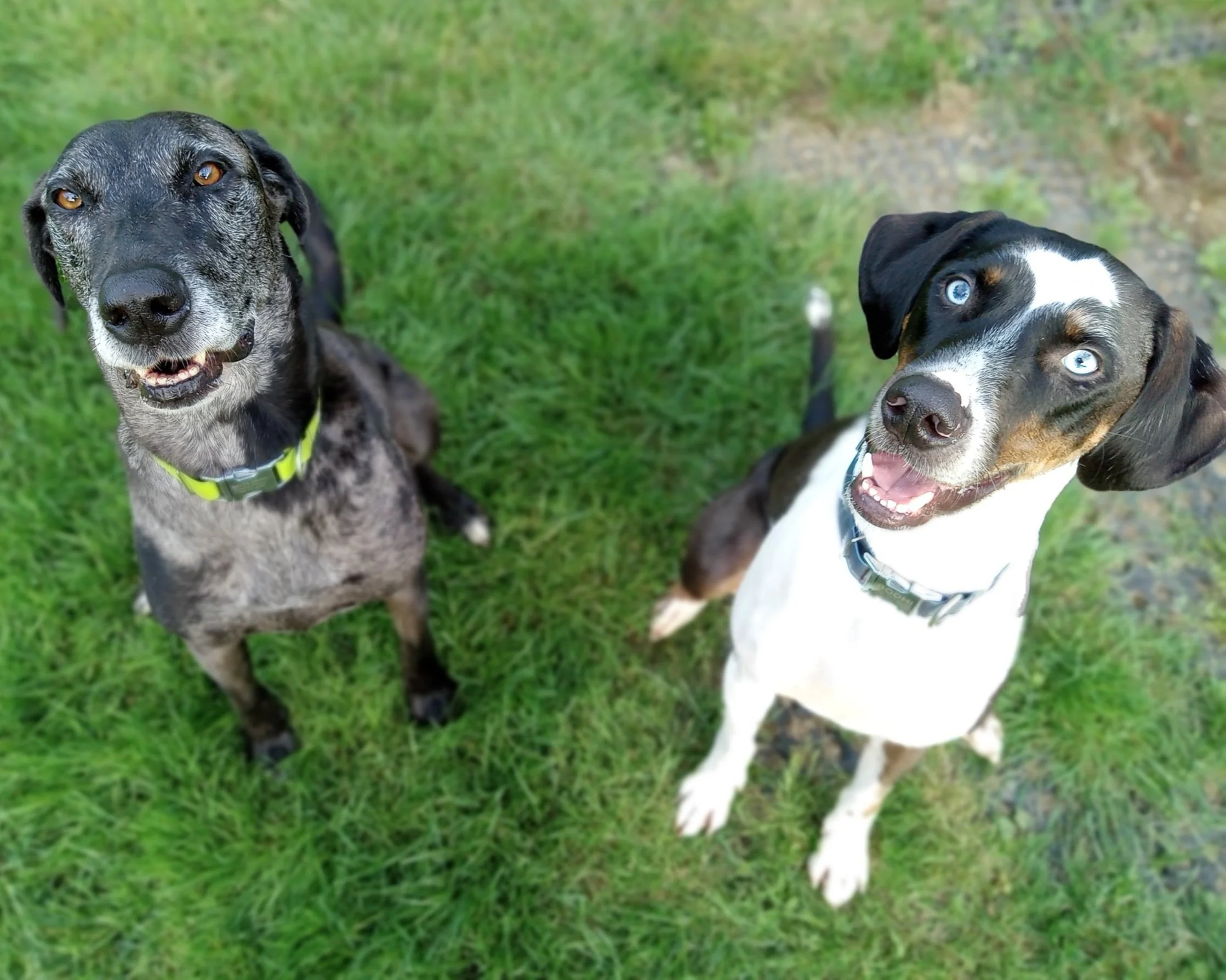
Speech therapy dog Delta at home with Bodhi. While not the best fit for animal-assisted speech therapy, Bodhi is nonetheless a beloved companion.
If you click a link it may be an affiliate link and I will earn a small commission. It doesn’t cost you anything extra. If I don’t use and love a product, you won’t find it here!
Multiple therapy dog pros-variety in your AAT offerings
Delta and Sky could not be more different.
Delta is large, generally slower-moving (though she has her excitable moments), and prefers to perform behaviors sitting or lying near a child (shake, deep pressure input “squishes”, finding treats in a dog puzzle). She rarely gives kisses but enjoys leaning against kids as they work.
Sky is small, rarely still, and thrives with high-energy and attention getting tasks like running through tunnels or playing fetch. She is a kiss-a-holic, which some kids love but others can find overstimulating or aversive.
Some of my clients show a strong preference for one dog over the other, so I take that into consideration when planning out therapy sessions. Depending on which dog I have with me that day I can incorporate the dog for a larger portion of the session or, conversely, fall back on more traditional speech and language materials and let my canine co-therapist have a break for that hour.
I like that this keeps some highly-reinforcing activities fresh for kids because they aren’t necessarily going to be playing fetch with Sky every week or getting heavy squishes from Delta.
Likewise, it gives my kids with emotional regulation and/or executive function challenges practice with recognizing another being’s preferences, generating compromise or alternative ideas to get their needs/wants met, and putting systems in place to prepare for upcoming sessions.
For example:
· we might look at a calendar to see how long it will be until they will see their favorite dog
· with my literacy kids I sometimes help them write a reminder note for a specific activity they want to do a particular dog in the future, incorporating a targeted spelling pattern into the words we chose, or
· we can practice asking for a specific behavior they are looking forward to with a targeted question form or phoneme. Even though that dog isn’t there, we capitalize on the positive feelings of looking forward to the next visit from that dog to reduce anxiety and improve working memory for the emerging skill
These different preferences for the dogs also provide natural opportunities to discuss perspective taking and consent.
With kids that are highly motivated by the therapy dogs, we will co-create “friend files” for each dog before generalizing that activity to humans in their life. In my experience I get better buy-in to the concept of social memory this way, likely because it circumvents the anxiety that discussing social interactions with peers can instantly elicit in individuals who have a strong history of difficulty building relationships.
And whether it’s for social-emotional learning, expressive language work on negation, or both, discussing what a therapy dog “does not” like/want/do is a great way to provide meaningful practice in a natural environment around consent and advocacy.
(Side note: For the past year or so I’ve had stuffed animal look-alikes for both Delta and Sky on hand, in addition to my favorite sensory-regulating tool “Heavy Puppy”. A few kids have been really drawn to the stuffies, imbuing with them with the internal motivations of their real-life therapy dog doppelganger. We can compare and contrast the two therapy dogs side by side using one stuffy and one live representative.)
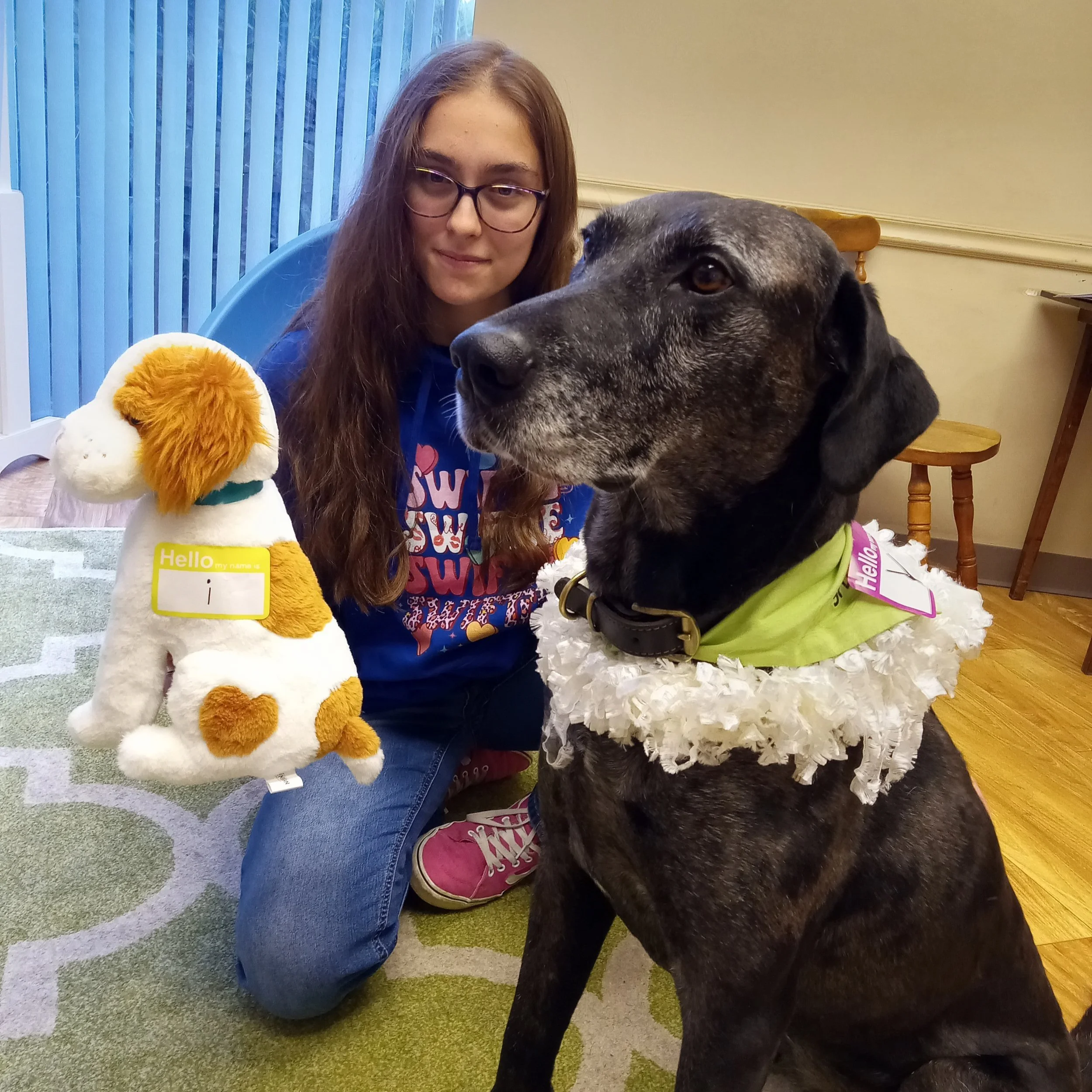
The personalities of “Little Sky” (standing in for the real thing) and reading therapy dog Delta are contrasted in a Wired for Reading (SM) story about the letter “y” changing to “i” when suffixes are added.
Multiple therapy dog cons—Mo’ dogs mo’ problems.
Finding a dog that is a great fit for speech therapy dog work is challenging. Any animal chosen should not just tolerate the work, but actually thrive in it. That’s asking a lot given that we work with populations who can be impulsive, show difficulty following directions, and may have motor differences that can lead to unintentionally rough handling. (See Balancing Valid Welfare Concerns with Potential Positives for Career Speech Therapy Dogs)
So if you intentionally set out to adopt or purchase a dog for the purpose of animal-assisted therapy, there is a very real chance that just like me you may end up with a wonderful companion that is just not suited for the work you envisioned.
While therapy animal selection is a huge topic in which some outspoken people have strong opinions, there is little scientific research to date. In other words, it’s a gamble.
So are you prepared to love and care for this new dog regardless of whether they are able to work with you? Can your finances and home accommodate adding more dogs?
I’m optimistic we’ll get more actionable advice on this topic in the near future, as AAAIP’s Dr. Taylor Chastain Griffin and others are trying to look more systematically at what characteristics within young pups are linked to the traits that make affiliative and resilient therapy dogs in the long run.
(Check out AAAIP executive director Dr. Taylor Chastain Griffin’s “How to Pick a Puppy” short video on YouTube and also Puppy Love and Selecting a New Speech Therapy Dog: Zephyr’s Story.) But don’t forget the possibility of adopting an older dog, whose true colors may be a bit more difficult to see at first given potential trauma that landed them in rescue and/or the stress of living in a shelter or short-term foster home.
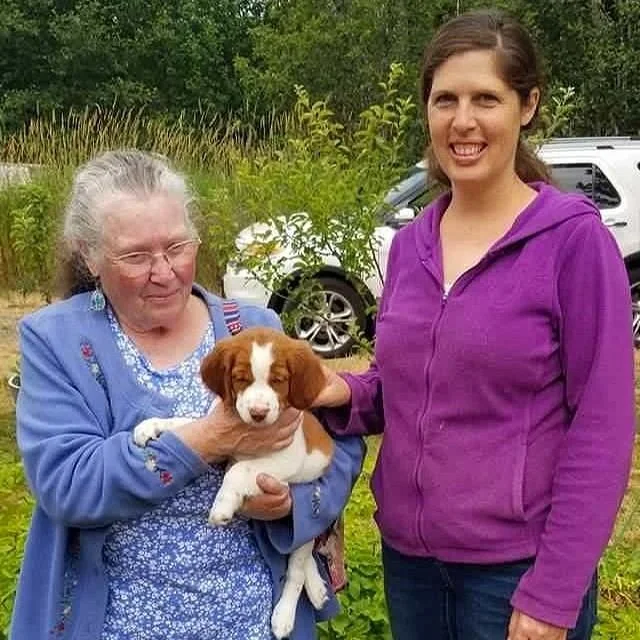
My mom and I with Sky the day she came home. Chosen solely to be my mom’s personal companion dog, it’s sheer luck she turned out to be a great animal-assisted speech therapy dog!
My personal hopes for future animal-assisted speech therapy
Until I can find a reverse-aging machine to plop Delta into, I know that within the not-too-distant future I will likely be looking for my next speech therapy dog candidate.
It’s a frequent topic of discussion in our home. What breeds should we consider? Puppy, adolescent, or young adult? How far are we willing to travel? Would we consider fostering a dog to make sure it’s a good fit before committing? How much are we willing to pay for the “right” dog? What behavior tests will we use?
At the same time, I honestly don’t feel ready emotionally just yet. And I remind myself often to stay present and enjoy these moments instead of worrying about the future.
But when the time is right, my Speech Dogs audience will be the first to know! (see update below)
To follow along on my journey to provide the highest-quality animal-assisedt speech therapy with my amazing speech therapy dogs Delta and Sky, follow on Instagram @speech_dogs or sign up for weekly emails by opting in for Your FREE Roadmap to Partnering with a Speech Therapy Dog. Check out the book and course while you’re on the site!
May your day be filled with puppy wiggles and children’s giggles,
Sharlet
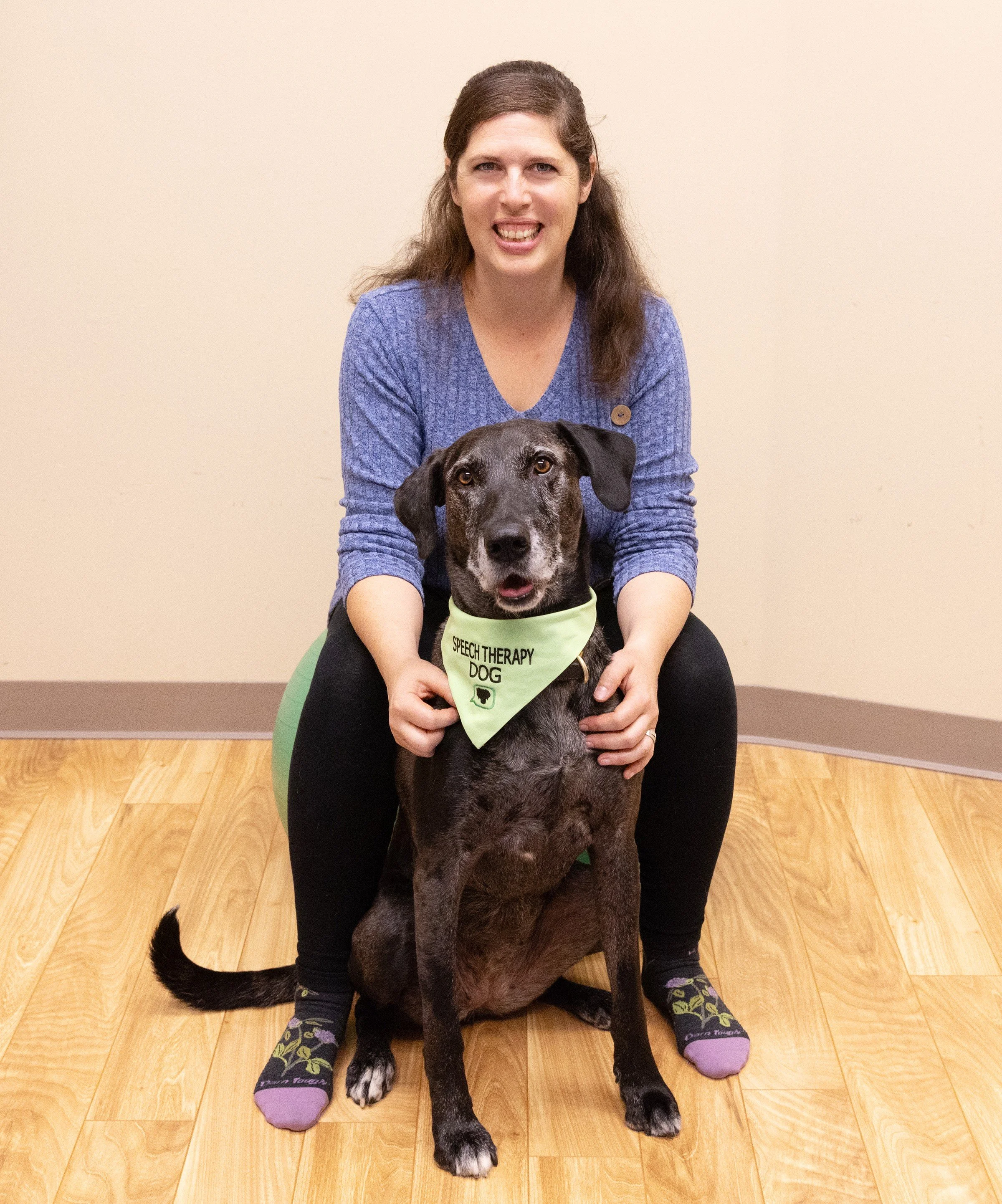
Update: Young Zephyr, adopted about 8 months after Johnny Utah’s passing, is just starting to transition into work. Yes, I’m back up to four dogs at home, plus my responsibilities for Sky who lives with my mom! So four and a half dogs?!?