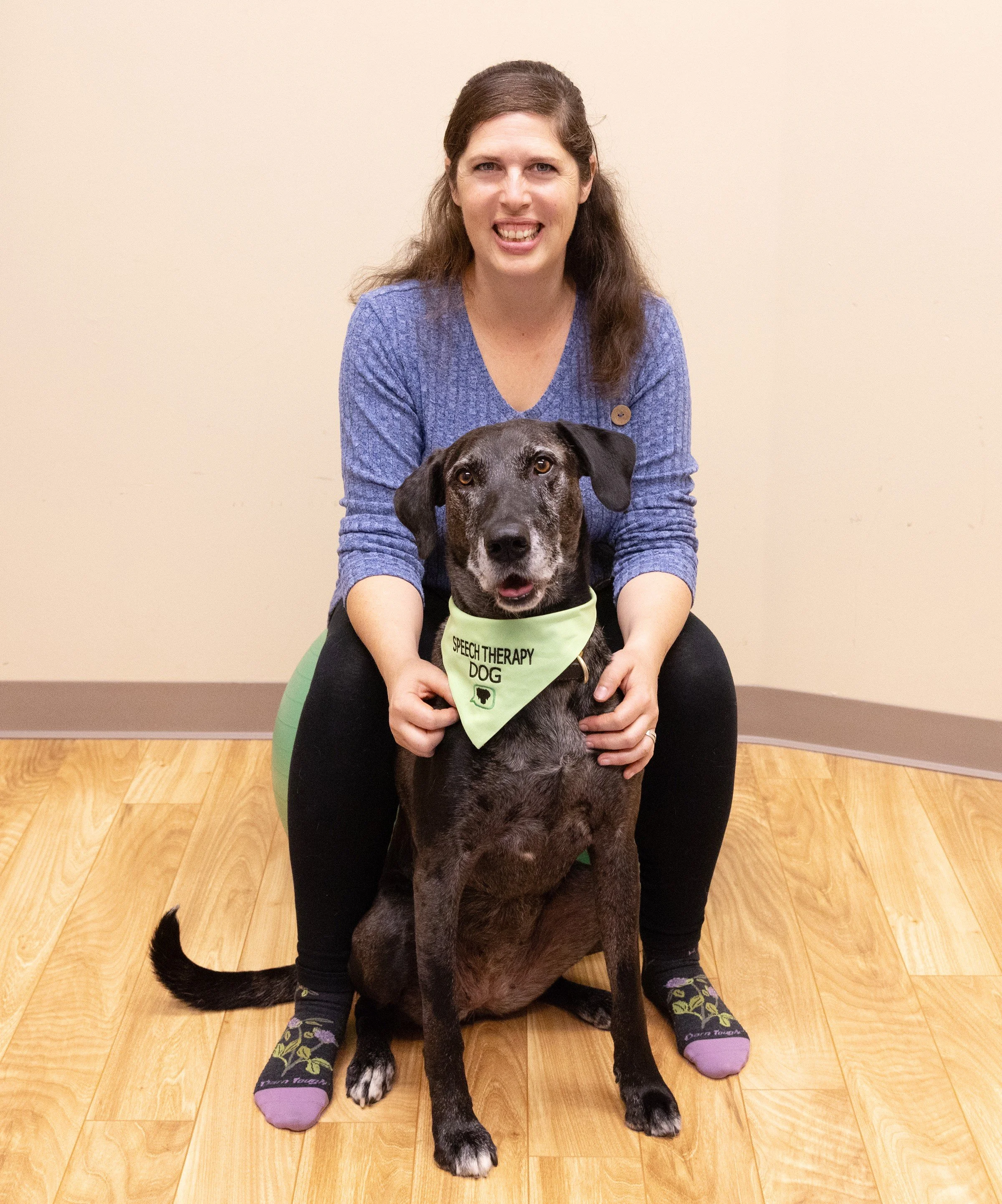
Fur-get About Dignity: How Our Speech Therapy Dogs Keep Us Humble
“Sometimes I think the primary purpose of the dog is to keep humans humble.”
Patricia McConnell, The Other End of the Leash: Why We Do What We Do Around Dogs
Shhhh…don’t tell my therapy dogs what I’m about to share with you.
I’m going to dish some dirt. Spill the tea. Air our dirty laundry.
(Okay, can you tell I’ve been teaching idioms at work lately?)
Sometime my speech therapy dogs Delta and Sky are the most dignified, mannerly, and obliging assistants I could ever wish for. They anticipate my needs, respond with perfect timing to a client’s emotions, and politely step back when we need some space.
But other times…well, let’s just say my dogs have been known to do some embarrassing things.
Delta sometimes gets really into licking her butt, loudly and repetitively smacking her lips in a water-drop torture kind of way that only gets worse when kids perseverate on wanting to know why she’s doing it.
Sky, an obsessive bird dog, has been known to spot a winged creature in the bushes outside the office window and start yipping like she’s being murdered.
Delta has become so obsessed a catching a fly in the office that she’s run head first into a wall. Loudly.
So if you’d like to indulge in a little scheudenfraude and snicker at some of the more embarrassing moments my therapy dogs have introduced to my life, keep reading…
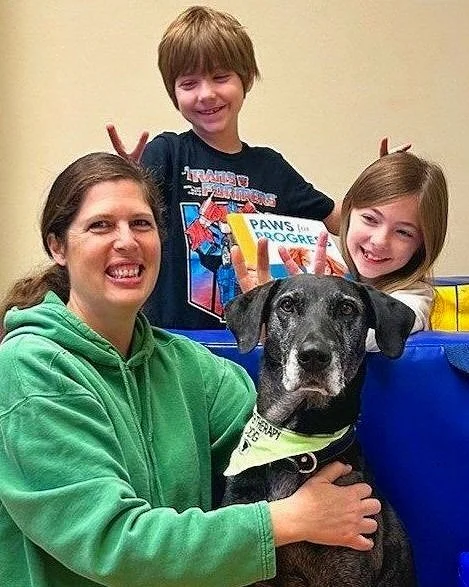
My speech therapy dogs enrich my work life in ways I couldn’t have even imagined, but that doesn’t mean they’re perfect! Sometimes our animal-assisted therapy sessions get a little embarrassing.
If you click a link it’s likely an affiliate link and I will earn a small commission. It doesn’t cost you anything extra. If I don’t use and love a product you won’t find it here!
Speech Therapy Dog Uh-Oh #1: Demand Barking
Oh, Delta.
She has taught me so much over the years, from finding ways to overcome her trauma-based introversion to problem-solving apparent training regressions. (Hint, it’s usually not the dog but some signal you’re giving, or not giving, that is actually the culprit. See “Un-Slumping” with a Team: Lessons from Dr. Seuss for Speech Therapy Dog Partnerships” for lessons I’ve learned working with an animal behaviorist).
While typically a calm, empathic rock I can depend on, with certain little clients she can become a bit excitable and need increased supervision on my part so as not to bump into kids who are small and easily unbalanced.
She is also not typically a demand barker.
One session though I was playing with an autistic preschooler who I had previously really struggled to engage. On this day I had managed to enter his world with a high-energy game of chase. It was perfect. He was giggling and making eye contact in anticipation of me rushing in for tickles.
But Delta was also rushing in, sometimes getting between me and the cherubic little boy at a critical moment.
Knowing she would probably whine a bit if I closed her in my office, I decided instead to quickly tether her to a cupboard in the corner of the room. Since I was right there and the boy had not shown much interest in approaching the therapy dogs, I wasn’t concerned about setting her up for resource guarding (something I’m always conscious of for safety’s sake).
I hadn’t anticipated, however, that she would give an ear-piercing frantic cry to demand release back to the game.
Seriously, I’m sure the entire office building heard it and wondered who was getting murdered.
In an ideal training session I would have probably ignored her until she self-corrected and calmly lay down to release her, but this was not a training session. It was a therapy session for a little boy with very significant needs that I had to attend to.
So Delta got rushed into my office with both a pre-stuffed Kong and a long-lasting chewer tossed in her direction to keep her busy. It worked and she’s never done anything like that since, but it was still humiliating.
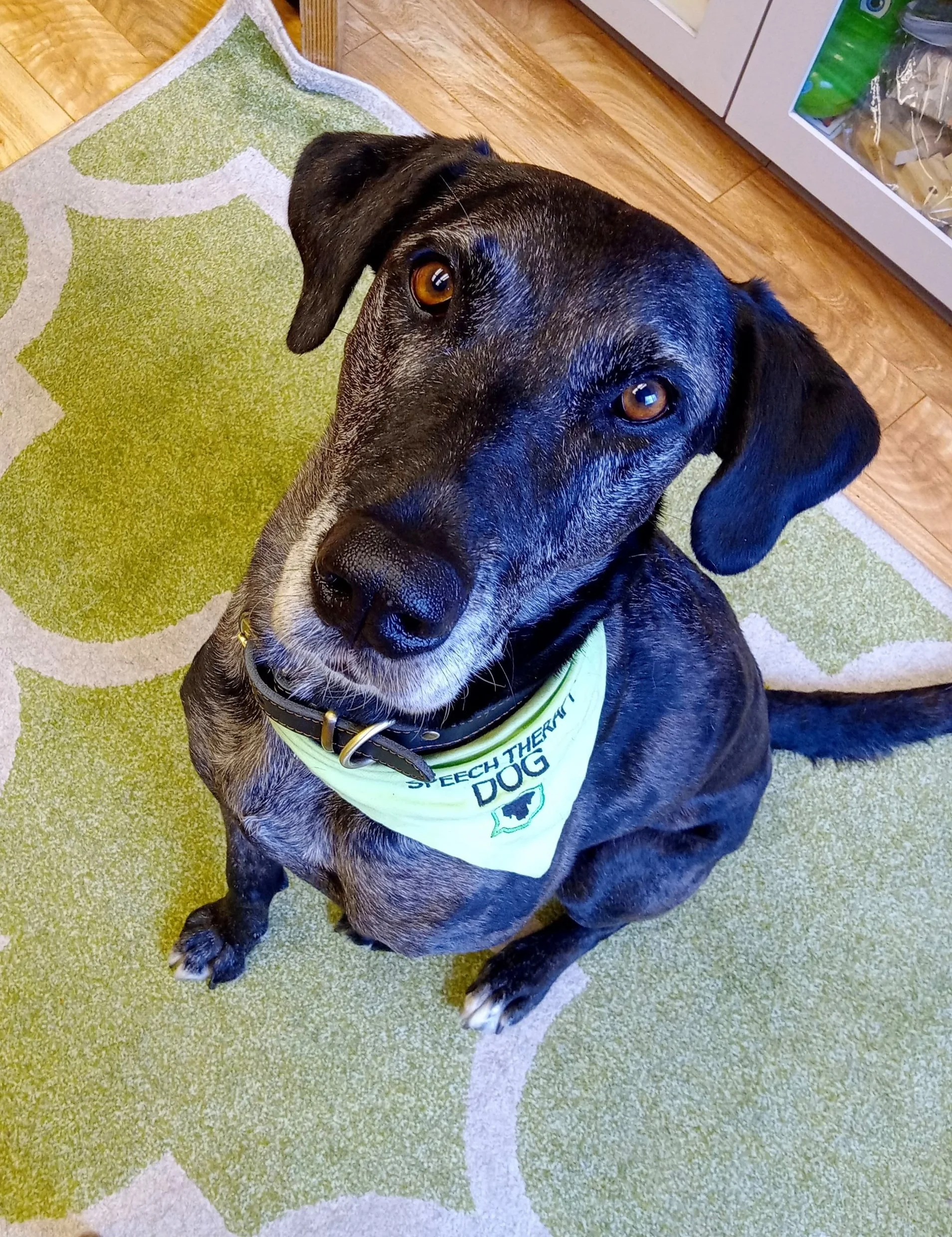
Sure the face looks cute, but don’t let Delta fool you. This usually well-behaved speech therapy dog can have rascally moments!
Speech Therapy Dog Uh-Oh #2: Accidents (from both ends)
There’s nothing like hearing a dog start to dry-heave to get my attention really fast.
There’s always that build-up as they run away from you, retching rhythmically. It’s bad enough when it happens at home; it’s worse when you’re in an enclosed office space with poor ventilation and an audience.
And it’s not something you can ignore and take care of when the session is over.
Nope, it’s glove up, bag-up what you can, wipe up the rest, and treat with enzymatic cleaner while simultaneously keeping therapy dog and child out of the way AND supervising to make sure everyone is okay. Then somehow corral off the spot, wash hands, and try to pick up the session where you left off.
Fortunately this has only happened to me twice in six years. I’ve actually had clients puke mid-session three times. And once a mom with morning sickness. So…it happens.
Urine accidents have made me blush a couple times too. I once had a parent say, “I think Delta needs to go outside” because she was standing at the door. Not wanting to look unprofessional I assured her without turning around, “She can wait, we only have a few more minutes.”
Reply: “Um, she just went.”
Turned out Delta had a bladder infection, diagnosed by the vet the next day after another accident at home. Urinary tract infections can be common in female dogs.
To avoid a re-occurrence I’ve added an inexpensive over-the-counter cranberry extract to her diet since then without further incident. According to my vet, dogs do not build up a tolerance to the active ingredient in cranberries (proanthocyanidins) and so it is safe to feed daily (but check with your own vet if you have any concerns).
The other moment of urinary incontinence occurred shortly after I started introducing Sky to work. One dad with a Dwayne “The Rock” Johnson kind-of build was enamored with her uninhibited gusto and got down on the floor to play.
She play-bowed. He play-bowed. (It was really sweet).
She thumped the floor with her front paws. He “thumped” (i.e., pounded) the floor with his palms and…
that was it. There was a river of urine as Sky skittered across the room to hide behind me.
He felt terrible, but I assured him she was just still learning. She immediately returned to him to give some submissive kisses and they were friends, albeit a bit more subdued friends, forever after.
However, I definitely made sure Sky had been outside right before his daughter’s session each week after that. Just in case.
Now, I have on numerous occasions experienced kids with diaper malfunctions or potty-training lapses, so I don’t consider the inclusion of a therapy dog to be any higher risk of office damage than typical wear-and-tear for a pediatric therapy clinic.
(Here’s the enzymatic cleaner I prefer, having tried out a few over the years.)
Speech Therapy Dog Uh-Oh #3: Mounting
Okay, this one is always a doozy. Once in awhile my dogs will get really overstimulated and try to mount a child (or me).
My dog trainer assures me this is not actually a dominance behavior as is sometimes believed, but actually a way dogs communicate to other dogs that it’s time to lower the energy level. It’s also featured in my favorite dog communication resource, the The Language of Dogs, as one of many calming signals.
But let me tell you, when it happens in an animal-assisted therapy session it keeps life interesting!
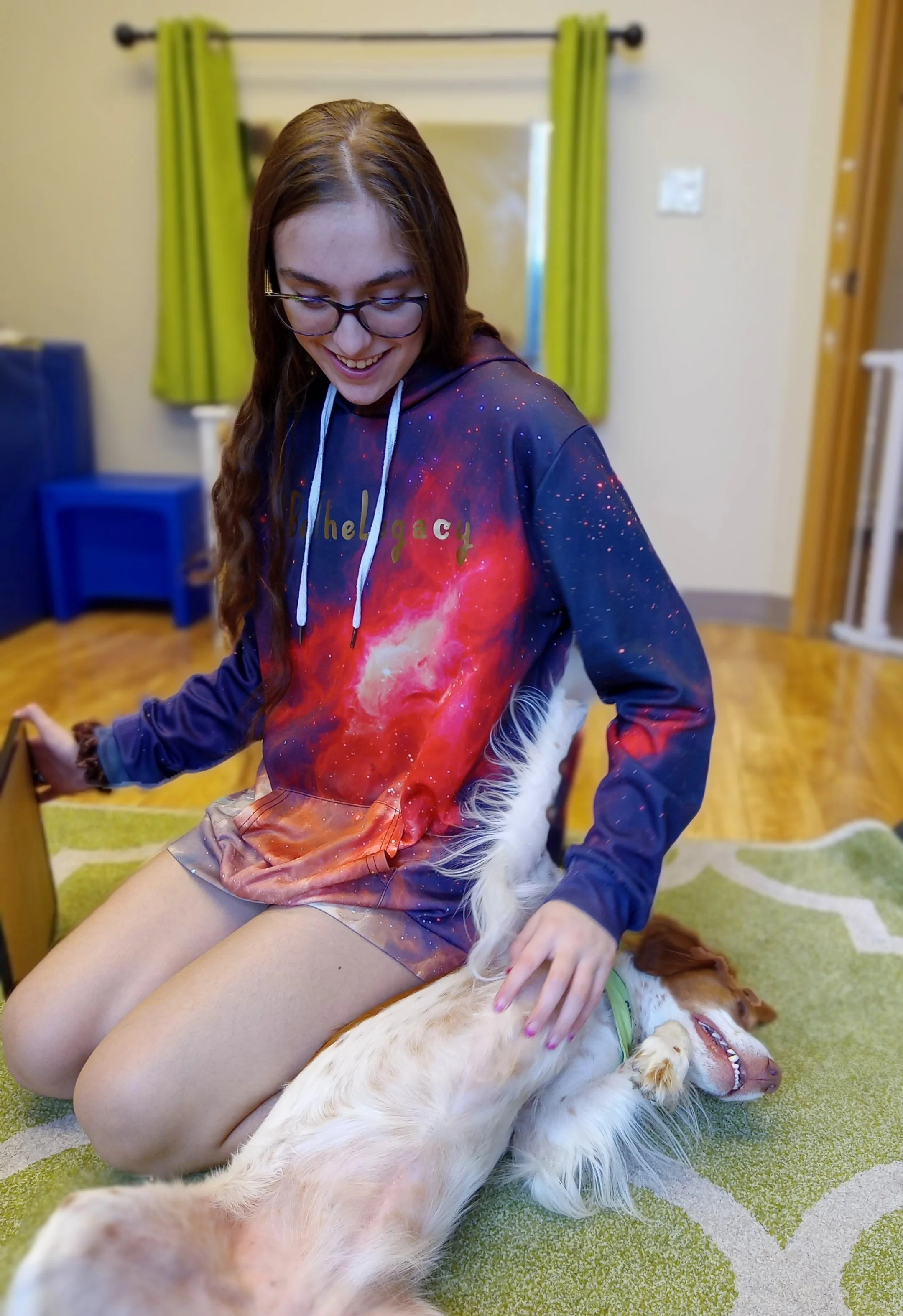
“Animal-assisted laughter” is a term I jokingly coined in response to Sky’s playful antics with our animal-assisted speech therapy clients.
Sometimes her antics get a little over the top though.
My spaniels, the late Johnny Utah and current partner Sky, have both had incidents when a child becomes almost manically excited and starts rolling around on the floor.
This is like bait to these two and they’re instantly on the kid, who usually responds by hooting even louder in laughter. The only solution I’ve found it to quietly but firmly remove my dog, give them a chewer in my inner office that doubles as a retreat space, and shut the door until all parties are a little more settled.
Delta, on the other hand, turns her awkward attention to me. This is probably good given that she weighs more than many of my young clients. But one time she took me so by surprise that she unceremoniously knocked me to the floor, at which point the client’s mom (not a pet owner) asked bewilderedly, “What is she doing?”
Um…
Again, I separated her. It can be great opportunity to work with clients on self-regulation and being flexible, since many of my kids enthusiastically ask the therapy dogs for deep pressure input “squishes.”
Since the dogs aren’t available, that means we get to problem-solve and find another way to seek that input (e.g,. with weighted items I keep on hand or asking a parent for a big hug) or trying alternatives such as heavy work (wheelbarrow walking, moving furniture, playing catch with a weighted ball) or a calming breath routine.
While these animal-assisted therapy moments are not our best and brightest, the reality is that these imperfect moments only make the truly great ones stand out more brightly.
Those moments when a connection between my therapy dog and client crystalizes and a usually challenging child suddenly becomes motivated to participate enthusiastically in a therapeutic endeavor.
Or when a typically irritable child comes through the door beaming, arms already reaching toward the dog for some love.
The moments when an impulsive and hyperactive child self-advocates for his sensory needs for the first time and requests a deep pressure input “squish” from one of the dogs.
Even those moments when I receive a proud text from a parent who has overheard their child saying something we had worked on with the therapy dogs to their own companion animal.
If you’re willing to overlook the occasional cringe-worthy moments and discover all the ways a speech therapy dog can enhance your professional services, check out Paws for Progress: Integrating Animal-Assisted Interventions Into Your Speech-Language Pathology Practice.
If you’re looking for an even deeper-dive with plenty of videos to illustrate key concepts, try Talk to the Paw! Therapy Animal Inclusion in a Professional Setting, 7+ hours divided in to 12 key lessons (plus a special bonus!).
May your day be filled with puppy wiggles and children’s giggles,
Sharlet