Training “Tails”: Building Skills with a Future Speech Therapy Dog (Part 3 Transitioning Into Work)
“Yeah, I’ve seen you flirting with me all class Zephyr,” the owner of another dog in our advanced obedience group said. With his own dog now in the car, he approached to let Zephyr do what Zephyr does best—wiggle and accept pets. My eight-month-old puppy was ecstatic and I couldn’t help laughing.
Zephyr has been growing—literally and figuratively—into a fantastic speech therapy dog hopeful. He absolutely loves people but has also learned to accept waiting for permission to go say hi (hence, the “flirting” where he stares at a person and thumps his tail every time they look his direction).
His response to direction is the best of any dog I’ve worked with to date.
And now he’s enjoying some brief outings to my office to try out the working life. While we’re a bit ahead of the schedule I had expected, here’s how we’ve been spending the last few months in preparation for a working career…

Zephyr watches with interest as a child completes a work task during his first time in an animal-assisted speech therapy session.
If you click a link it may be an affiliate link and I will earn a small commission. It does not cost you anything extra. If I don’t use and love a product, you won’t find it here!
Generalizing helpful therapy dog skills to new environments
Zephyr is the fifth dog I’ve gone through the whole training process with, so I feel pretty solid on basic training principles. I also have two trainers from different backgrounds/specialties I can call on if I need help. Adolescent dogs are notoriously challenging to train as they may choose to ignore you or become more distracted than when they were little pups. Zephyr nonetheless learns very quickly and seems to retain things well even as he enters this phase of maturation.
So at this stage I’m really trying to solidify the behaviors I know will be most helpful while using more subtle cues, less obvious reinforcement, and in a wider variety of contexts.
For example:
· we practice “back up” as I prepare his meals, fading to just a hand signal with a quiet “yes” marker when he responds (knowing in just a few moments he’ll get a whole meal as a reward)
· we practice “with me” (loose-leash walking around stores and through town), trying to go a whole aisle or block before treating but still giving a “yes” or “good boy” each time he looks up at me to shows he’s still focused
· we practice fun skills like “high-five”, “wave”, and “spin” as well as “get it/bring it/drop it” before he gets a toy tossed during our evening play (still working on roll over, he just doesn’t seem to enjoy that one even though he lies on his back to chew on toys all the time)
· we practice “step” to walk on benches, railroad ties, and pallets along our town streets, giving lots of behind the ear scratches and enthusiastic kisses while he’s standing up on an item in preparation for possibly sitting on the swing or ball pit with kids
· we practice “wait” naturally at gates, road crossings, and before greeting new people with the reward of getting to run up for a snuggle when released
· we practice “go to your bed” at random moments with a big “party” (i.e., cheers and pets) when he gets there and lies down
Overall my goal is for him to watch me for direction even when there are distractions and temptations and to find as many ways to reward him as possible so I’m not dependent on always having treats on me when I’m in the office.
(That said, I do always have treats on me when we are in a new situation. A powerful technique I learned from taking a course with Tim Pratt of Diverse Dogs is the “treat scatter” to switch a dog from fight/flight/freeze to thinking mode by capitalizing on their strong instinct to follow scents. When we do have an occasional startle, such as the very real experiences of being rushed by a strange dog or spooking at a balloon arrangement in a store, I take him a short distance away and toss treats on the ground to find with his nose. This has been a game-changer with my dog Bodhi, who can become stressed by loud noises and a great tool for my training repertoire.)
Transitioning into life as a working speech therapy dog
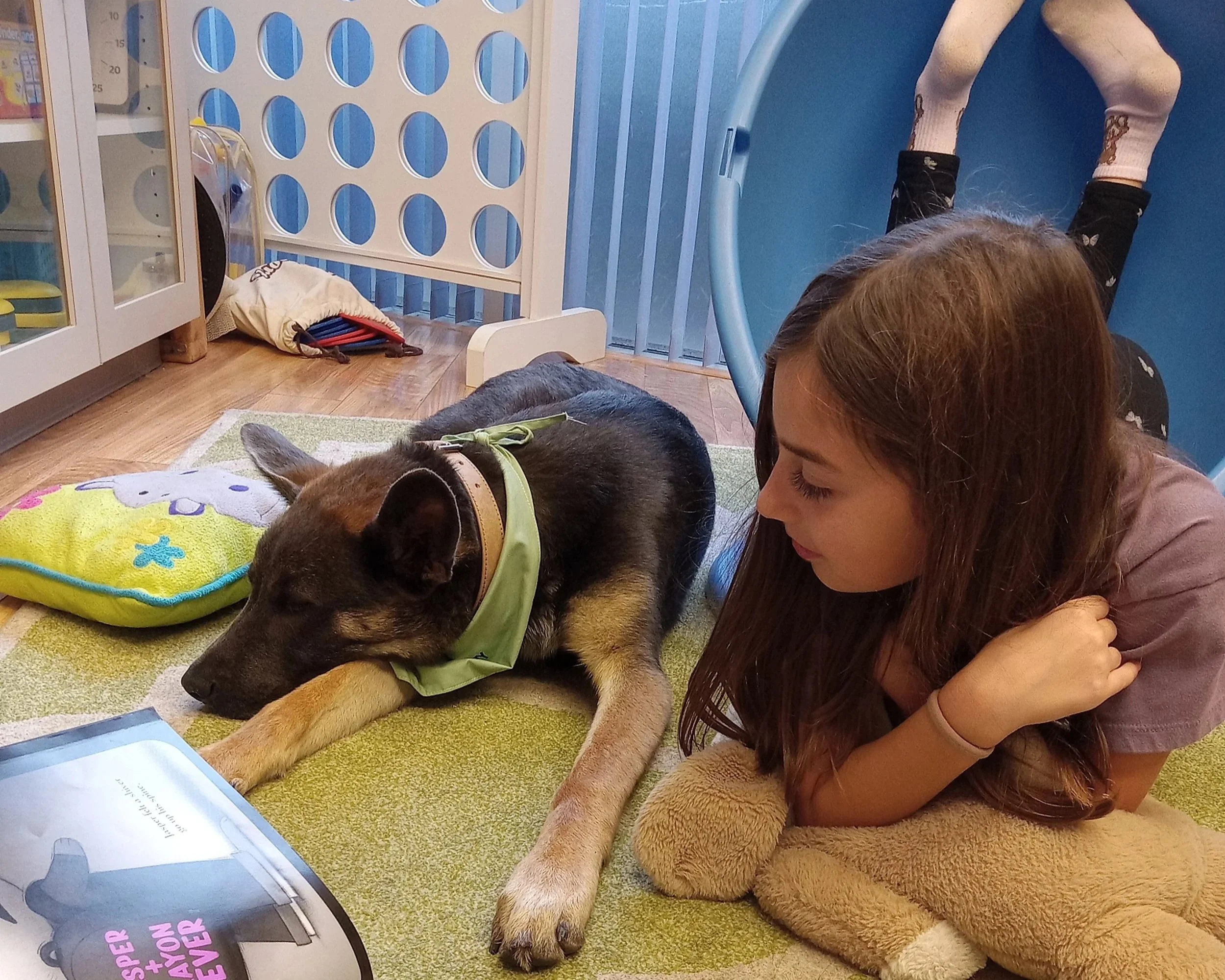
Speech therapy dog Zephyr, at the end of a short work day, showing his preference for staying near the kids.
Going to work is a big task with many components that can vary tremendously from day to day and moment to moment. Clients who can be unpredictable due to their age or needs. To avoid overwhelming Zephyr and help him develop a positive association with coming to work, I’m trying to give him as many enjoyable experiences as possible before introducing him to more difficult situations.
Like putting pennies in a piggy bank, my goal has been to give Zephyr lots of easy, successful outings that leave him feeling excited to play with kids. At six months of age I started inviting particular families to meet me at the office for short play dates with Zephyr. Since each meeting went smoothly, I decided to flex my schedule a bit and have him come for 2 hours a week with a couple particularly dog-savvy families who excitedly volunteered. As a solo private practice owner I’m fortunate to have a lot of flexibility in how I schedule clients.
The first few weeks of this work experience he was a bit overly excited when families would enter, with one submissive urination and some jumping up. (Always good to have a safe, effective cleaner on hand!) Stepping on his leash as people approached so he couldn’t jump paired with lots of praise and a treat for staying down was a pretty quick fix.
One of the kids preferred to sit on the floor with Zephyr which led to some hilarious moments of “puppy attacks” with distracting kisses (for a fun, quick video click here), but overall he mostly remained calmly nearby as we worked. It was a treat watching his affiliative behaviors (for more details, see Therapy Dogs Explained: What is Affiliative Behavior on the Speech Dogs YouTube channel; for a clip of Zephyr displaying them click here).
His affiliative behaviors have consistently been sky-high, independently choosing to sit or lie next to children instead of me and following them about during more active play. It’s been exciting to see as he doesn’t have much exposure to children outside of these work visits, so this is truly an inherent part of his nature.

Zephyr doesn’t get too concerned even when unexpected things happen during an animal-assisted speech therapy session, though so far he’ s only been asked to work with cooperative clients as he builds confidence.
I didn’t ask for a lot of specific behaviors on his part for the first several weeks, then added in one brief active participation activity per session for the last few weeks.
I also took a few moments toward the end of a few sessions to work on developing “squish”—the deep pressure input that many of my clients seek out with my more experienced therapy dogs (see Squishes, Deep Breaths, and Therapy Dogs…Oh My! How a Speech Therapy Dog Can Improve Sensory Regulation for more details).
True to his chill temperament, Zephyr seemed totally relaxed lying on a calm child’s back for about 20-30 seconds. Of course we’ll need to generalize this to longer periods and different sizes and level of “wiggliness” of children, but it seems like a technique he’ll be comfortable applying in the future.
Initially he got very tired. Each week his stamina improved though and after a couple months I scheduled one additional child for Zephyr’s day. He not only interacted through all three sessions, but was alert and awake in the car leaving the office as well. The extra effort didn’t seem to overly stress him by that point.
Why I’m NOT Bringing Zephyr Full Days Yet
Even though Zephyr is doing great, I’m conscious that he is solidly in that 6-14 month developmental stage where fears can easily develop (see Fear Isn’t Failure: Helping Your Young Therapy Dog Candidate Through Emotional Growing Pains) and that he also still needs a lot of rest as he grows.
So as tempting as it is to try going to a full day (he’s about nine months of age as I write this), I have decided to keep bringing him for little stretches while mixing up which kids he’s meeting. I’m still keeping it to my more predictable kids while avoiding families who are less comfortable around dogs and clients who sometimes have outbursts. I want to just to keep adding those positive experiences.
I won’t be able to shield him forever and eventually Zephyr will encounter the occasionally difficult moments of animal-assisted speech therapy. The stronger he associates coming to the office with joy though the less impact those moments should have on his overall working attitude.
He also is still actively growing, which means his need for sleep is even higher than an adult dog, who already requires 16 hours a day on average! I want to avoid having him associate work with feeling crummy, which would likely happen if I didn’t give him much more down time than is often possible during a work busy day.

A sweet end to Zephyr’s first session of animal-assisted speech therapy, showing how tiring new experiences can be for a puppy.
Finally, and this one is somewhat unique to Zeph, we are still (still!) trying to get a handle on some gastrointestinal issues he’s had since we brought him home. Though he seems to feel great and is now putting on weight steadily, he initially had a wrecked gut microbiome that really impacted his early development. I’ve consumed so many podcasts, books, and websites about gut health that my mind is swimming, and yet he still have a few minor symptoms his vet and I are trying to figure out.
I don’t want to put him in a situation where he is likely to have accidents in the office and/or turn people off with noxious gas. Fingers crossed this next vet appointment will find the answer.
Continuing to build the bond with my new speech therapy dog hopeful
I love taking Zephyr to new places. Experiences like camping, going to an outdoor dog-friendly restaurant, meeting friends at new trailheads, and even something as simple as eating a drive-through meal in a parking lot together has helped me observe all his little nuanced communication signals. His ears are super expressive, but his tail carriage tells me a lot too. I know that as I start to build in the challenges of work I’ll be able to rely on our bond and two-way communication to support him when needed.
My plan at the moment is to wait until he’s 14 months to start bringing him for full days, which will be around Valentine’s Day. For January and February I’ll get help from my husband to bring him for half-days to help with that transition. It’s bittersweet because it also means slowly reducing Delta’s work days from two days a week to one, with the understanding that should she need to retire completely Zephyr will be there to help take up the slack (Sky will continue one day a week). I’m hopeful that is still a long ways off in our future, but I know that it is looming.
(To hear more thoughts on when and how to retire a therapy dog, check out my appearance on the Therapy Dogs Australia podcast Season 4 episode 6. The audio is a little wonky for the first few minutes, but then gets better.)
Your Speech Therapy Dog Candidate
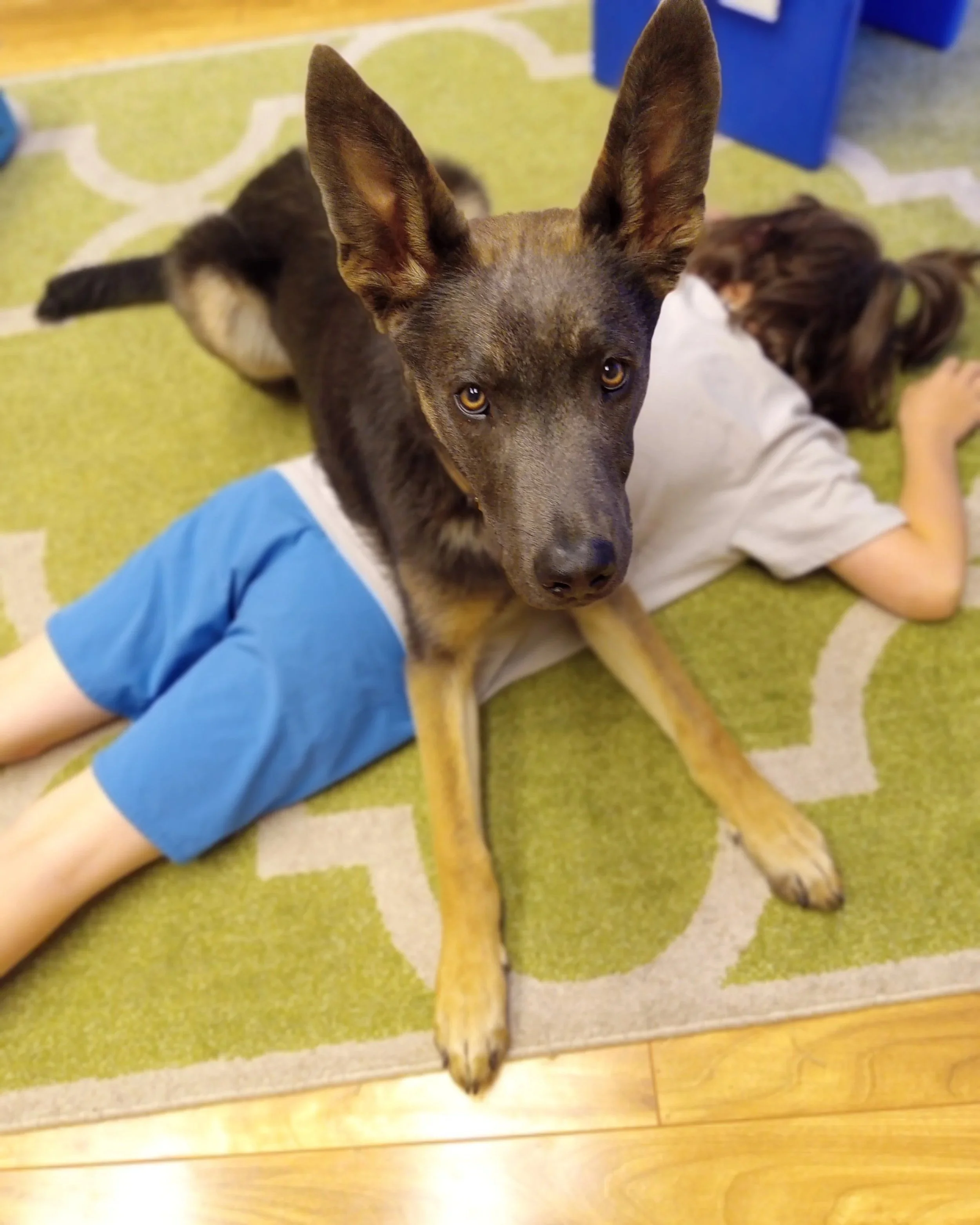
Zephyr practices what may become a big part of his job, helping children in animal-assisted speech therapy by providing deep pressure input for sensory regulation.
Here he is starting with a very cooperative child who knows to lie very still to help the future speech therapy dog build confidence.
Of course every therapy dog hopeful is unique and every handler’s experience in readying a dog for work is going to be different as well.
Zephyr has progressed at a quicker rate than I had expected. His temperament is naturally very calm and inquisitive and he stays focused more easily than any puppy I’ve worked with before.
My spaniel partners, Johnny Utah and Sky, were much more likely to become hyperactive around new people and were older before they could focus on me in new environments. Yet they still turned out to be amazing at their job in the long run. And Delta came to me with a lot of anxieties around meeting adults, especially men, so her progress was often two steps forward one step back.
I also know exactly what behaviors I prioritize for work because I live this every day and have let go of the perfectionist mindset I had when I started AAT. But I’ll feel confident Zephyr (and any future therapy dog partner) is ready when he:
· is able to ask to go outside and then does his business efficiently in the appropriate place
· walks calmly past people in the building’s hallsways
· responds to cues to back up or move to a different spot as needed in case a child becomes overwhelmed
· independently finds a comfortable spot or relax to rest without my needing to micromanage him
· bounces back quickly from small startles that inevitably happen
· is able to leave off limit items alone (e.g,. children’s toys in the waiting area) without vigilant supervision
So regardless of where you are in preparing your therapy dog hopeful, stay patient and let me know if I can provide you any support by emailing me. I am not a dog trainer myself so I can’t answer specific training questions (though I may be able to guide you to resources), but I’m happy to give you support about what to prioritize as you go through the process.
To learn more about working with therapy dogs in general check out the book Paws for Progress: Integrating Animal-Assisted Interventions Into Your Speech-Language Pathology Practice and the self-paced, online course Talk to the Paw: Foundations for Therapy Animal Inclusion in a Professional Setting.
Stay tuned for an update article as Zephyr works up to his first full day as a professional speech therapy dog. In the meantime, check out Sky’s First Day: A New Speech Therapy Dog Learns the Ropes of Animal-Assisted Therapy from April of 2024.
May your day be filled with puppy wiggles and children’s giggles,
Sharlet

Update: Thanks to a scheduling opportunity, I brought Zephyr one week to meet a client who especially loves the dogs but can be more challenging due to his frequent loud noises, less-controlled motor movements, and excitability. Both Delta and Sky needed a little time to feel fully relaxed around this particular boy, but now accept his extraneous movements and vocalizations without fear.
I allowed Zephyr to back-off whenever he wanted (he only went a few feet) and made sure the boy and I stayed in the middle of the room to give him space to do so. As expected Zephyr was a little less confident in this boy’s presence, showing some tongue flicks and retracted ears, but consistently returned on his own to interact with him.
Zephyr seemed most comfortable when given a specific job to do, such as providing brief squishes, being directed where to move, and going through the tunnel. He was least comfortable with the tall boy leaning over him, so I made sure to pair high value treats with these moments to help develop a positive association.
Any time we sat at the table Zephyr came near to lie down and seemed quite relaxed. If we got up to get an item he happily followed us, often trying to give the boy a kiss.
Since I knew it would be the most stressful situation he had been in to date, I made sure Zephyr got to go home right after. I will be working to make sure Zephyr desensitizes a bit to people leaning over him while also encouraging clients around getting down at his level instead.
Related articles: